

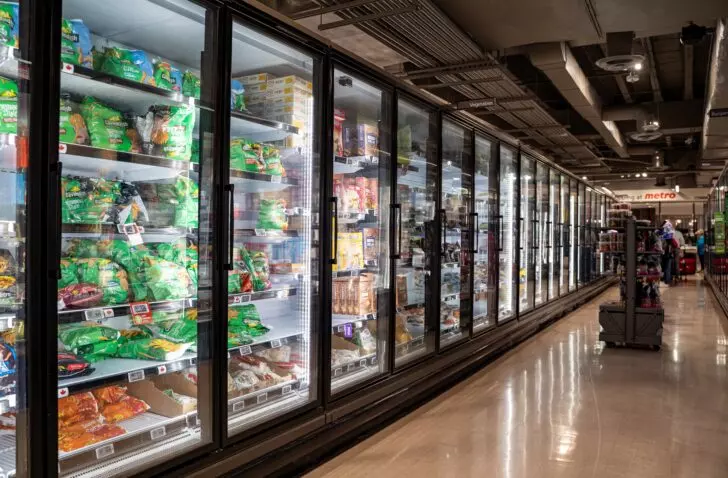
A cyber incident has disrupted the cooling systems of more than 70 Belgian supermarket chains. Stores are emptying their freezers.
During the night from Sunday 1 November to Monday 2 November, cybercriminals carried out an attack on the cooling systems of Belgian supermarkets. The attackers switched the evaporators to defrost mode, causing items in the refrigerators to warm up. In Belgium, more than 70 supermarkets were affected, including Delhaize, Spar and Carrefour. Similar problems also emerged in other countries, such as Estonia, Germany, Sweden, Luxembourg, the Netherlands and Italy. Stores emptied their freezers and are being forced to throw away large quantities of food. The federal prosecutor’s office has meanwhile opened a criminal investigation into the cyberattack, according to VRT NWS.
It is not the first time that hackers have targeted supermarket cooling systems. In mid-October, cyberattackers hit the cooling systems of French supermarkets, causing millions of euros’ worth of food to thaw. Albert Heijn and Delhaize were also hit last month by a cyberattack that took down their websites and logistics systems for an extended period.
Cooling systems disrupted
These cyberattackers are targeting not sensitive company data or personal data, but the cooling systems of supermarket chains. More than 70 Belgian supermarket chains have now been affected and have been forced to empty their freezers. Some of the affected stores are known. According to VRT NWS, they include Delhaize Boortmeerbeek and Sint-Truiden, Proxy Delhaize Grootzand Dendermonde, Sint-Amandsberg, Hoepertingen, Kouter Gent and Carrefour Heist-op-den-Berg.
According to Het Belang Van Limburg, the damage at Proxy Delhaize in Hoepertingen is “immense”. Temperatures in the freezers rose from -22 degrees to fifteen degrees. “I estimate that we have thrown away at least 60,000 euros’ worth of food,” said store manager Gerte Bouchet.
Vulnerable systems
Geert Baudewijns, CEO of Secutec, points to the management of those cooling installations. This usually lies with an external party that also sells the refrigeration units with a maintenance contract. “These people specialise in designing a refrigeration unit, but they are not really at home in the world of writing software,” he says. “That software is very often outdated, which is why such vulnerabilities are discovered in it. If you then don’t have a team that can help upgrade it, you’re left with a vulnerable product.”
Attackers without a revenue model
Who is behind the attacks is not yet known. Baudewijns sees a different kind of attack from what has been usual over the past ten years. Commercial hackers use ransomware to demand a ransom for decrypting a network or to prevent data from ending up on the dark web.
“What we are seeing now are hacks in which something destructive happens, with no commercial goal and without any information being extracted,” says Baudewijns. “Those refrigerators know nothing about customers. It’s simply switching them on or off and regulating a temperature.” He thinks more of students or activists.
He does not want to draw a link with Russia. “I wouldn’t dare to. No proof of that has ever been provided either.” He does say that it is a hundred times easier for a student today to carry out such an attack than 25 years ago. “Back then, a student needed quite a bit of technical knowledge. Today that is minimal, and with artificial intelligence you can get really far.”