

With Project Perception, Microsoft announces a security system built entirely on AI. AI agents are designed to detect, assess, and address risks.
With Project Perception, Microsoft reveals a concrete vision of what the future of cybersecurity could look like. Project Perception is not intended to provide security teams with more alerts, but to help reduce risks themselves on a permanent basis. The system combines signals, security context, models, and specialized AI agents into one overarching, autonomously functioning whole. According to Microsoft, employees do retain control over the platform’s actions.
Blue, green, and red
The core of Project Perception’s operation consists of three classes of AI agents. Red team agents search for potential attack paths before attackers can exploit them. Blue team agents investigate signals, place them in context, and determine which risks are relevant to the organization.
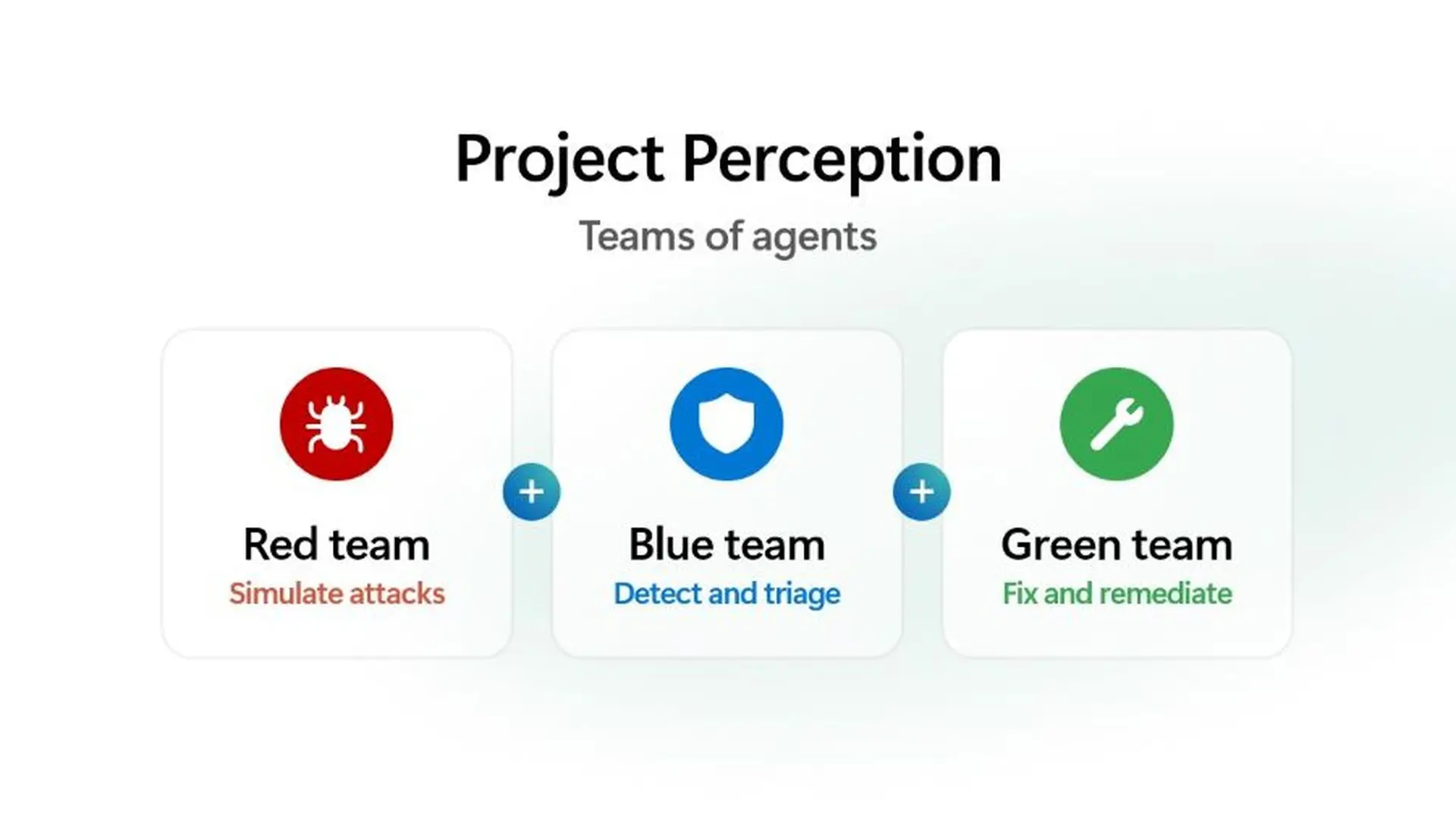
Green team agents then perform corrective actions and must strengthen defenses. Together, the agents form a closed system that continuously investigates, evaluates, and improves an enterprise’s security posture. Microsoft describes this as an approach that can perceive, reason, and address risks at machine speed.
New stack
Underpinning Project Perception is a new cybersecurity stack. According to Microsoft, this is necessary to support the new AI-based approach to security.
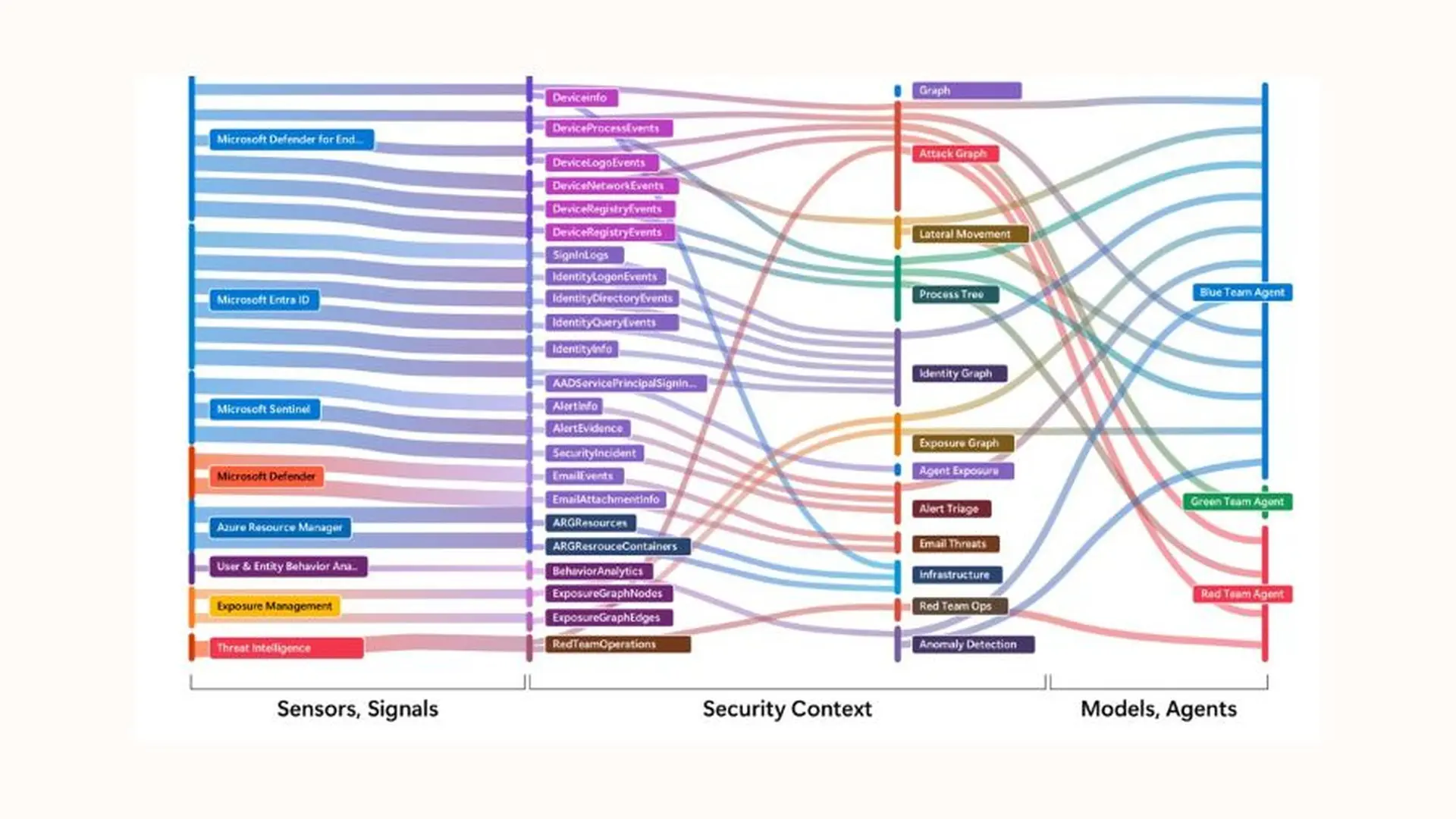
The foundation of the stack consists of sensors that perceive signals from the digital environment. A security context then converts that information into a shared view of assets, identities, relationships, risks, and activities.
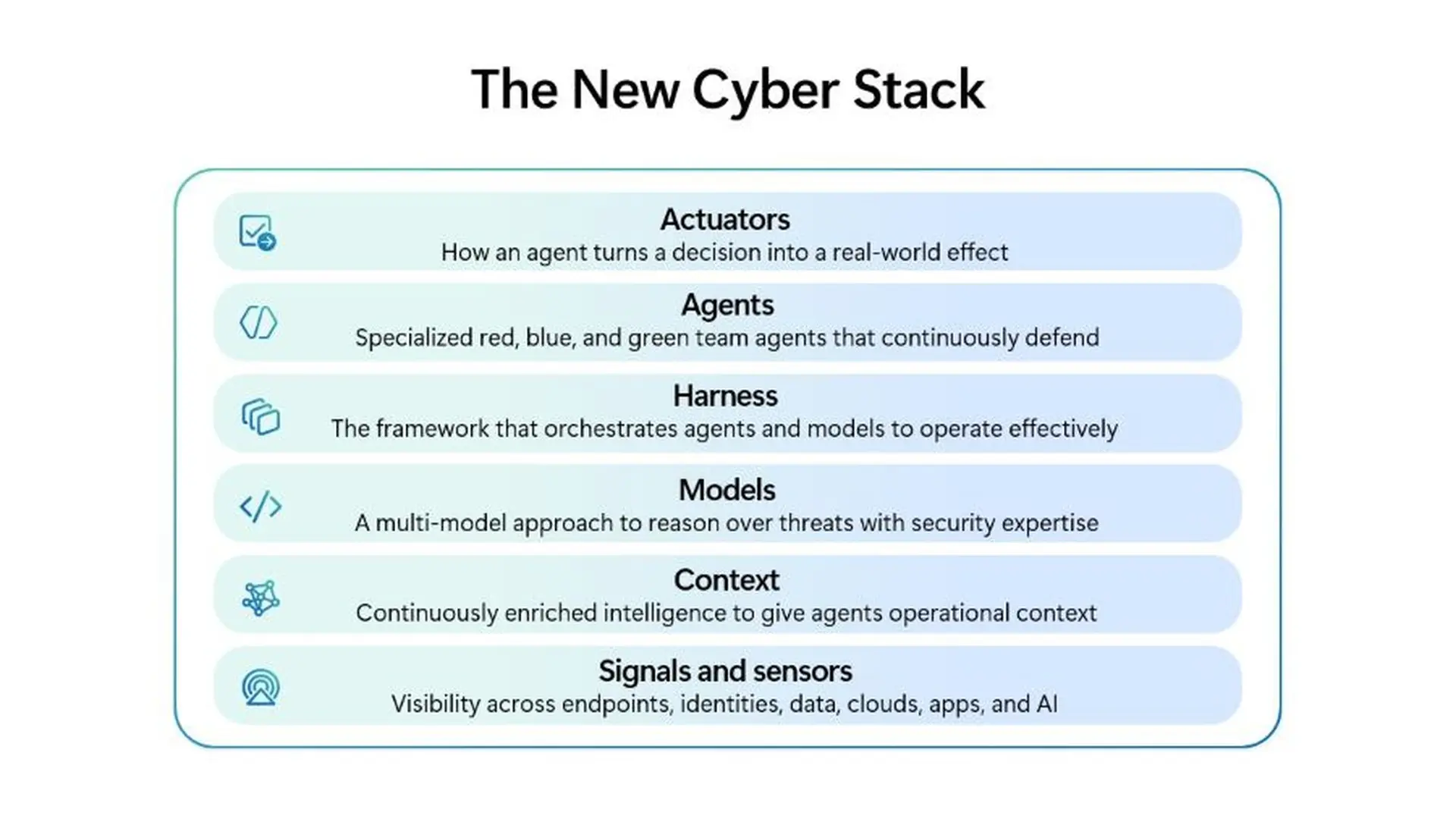
This context is intended to prevent each AI agent from having to collect and correlate raw data itself. Next, a layer for models and agents coordinates the various security workflows. Microsoft has built a harness (framework) in which these LLMs function. Agents operating within the harness belong to the aforementioned red, green, or blue teams.
So-called actuators translate decisions into actions within Microsoft Security products, so that Project Perception can not only identify risks but also address them.
Multiple (open) models
Microsoft does not use a single AI model for Project Perception, but an architecture with multiple models. The system must select a model per task based on quality, reliability, latency, and cost. According to Microsoft, this is necessary because security must be permanently available, but also evolves rapidly.
Microsoft recently joined the Open Secure AI Alliance. This alliance consists largely of the world’s largest technology companies and aims to support and promote open AI models in the context of security. A multitude of open models benefits security and allows Project Perception to evolve quickly without costs for users becoming high.
Proprietary LLM
The first concrete application of Project Perception is software vulnerability management. For this, Microsoft is adding MAI-Cyber-1-Flash to MDASH. This is a team of models and agents for that domain. According to Microsoft, this combination achieves 96 percent on the CyberGym benchmark, twelve points more than Mythos, while costs are said to be nearly fifty percent lower than the current MDASH configuration.
Project Perception will be available as a public preview on August 3. Microsoft intends to deploy MAI-Cyber-1-Flash for other security workflows later. The company states that the system aligns with its principles for responsible AI and adopts existing controls around security, compliance, and management.
Security at machine speed
The announcement shows how the center of gravity of security is poised to change. Although Microsoft points out that humans still play an important role, a shift has begun. Cybersecurity is evolving into a battle between code and machines. Humans are given a management role, but vulnerabilities are sought, evaluated, and even resolved at machine speed.
Whether Project Perception lives up to that promise, works with sufficient accuracy in practice, and can effectively automate actions remains to be seen once customers can get started with the preview. In the meantime, the initiative already outlines a possible future vision of security in a world with AI.