

Microsoft introduces an integrated security operations center (ISOC) in Microsoft Defender. That is a sophisticated name for a system that monitors continuously with the help of AI.
Microsoft presents ISOC, short for Integrated Security Operations Center. The integration in question is with Microsoft Defender, of which ISOC becomes a part.
Fighting AI with AI
The platform brings security information and event management (SIEM) and threat protection together in a single environment, without organizations needing to link additional separate tools. In effect, Microsoft is integrating the capabilities of its Sentinel solution into Defender with this move.
Rob Lefferts, corporate vice president of Microsoft Threat Protection, states in a blog post that handoffs and integrations between separate systems slow down defenders. ISOC aims to remove that complexity by bundling signals, context, and controls into a single whole.
Microsoft is convinced that this approach is necessary. Attackers are reportedly increasingly deploying AI agents to automate attacks on a large scale. Responding to this with a classic, more fragmented security architecture is too slow in that context.
Microsoft’s new security stack
ISOC in Microsoft Defender gives security teams and AI agents a shared foundation to oversee, understand, and respond to the IT environment. The platform bundles three pillars in the cybersecurity stack according to Microsoft.
- Signals and sensors make the system aware of what is happening in the IT environment
- Context ensures that a correct interpretation of the signals is possible
- Actuators make it possible to convert insights into concrete protective actions in the environment.
On top of that runs a layer of AI agents, linked to a system with orchestration, model management, and a powerful framework. That layer is not new: Microsoft announced that part of its cyber stack in June under the name Project Perception.
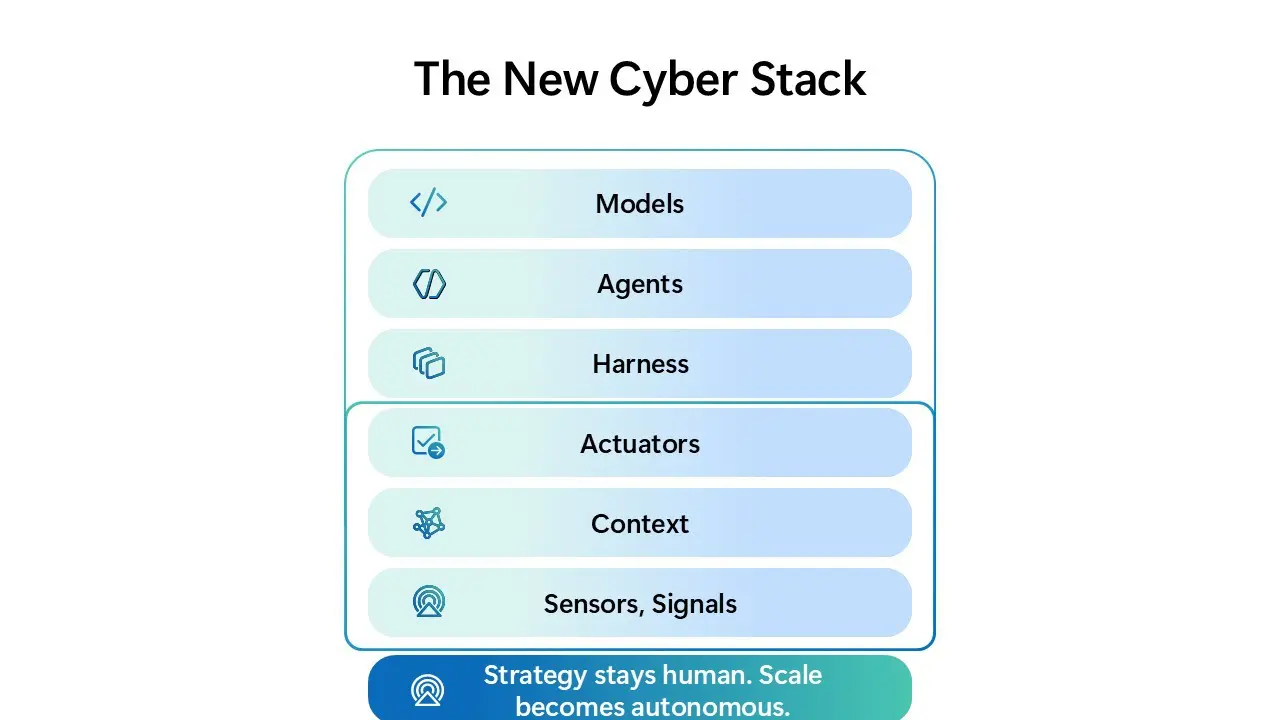
Project Perception should already give AI the ability to detect, assess, and address risks. As early as June, Microsoft set out its vision for the new cyber stack with a major role for AI. Project Perception already brought intelligence and integration with it. ISOC is intended to broaden AI-driven monitoring, detection, and remediation to the entire organization.
External connections
To this end, ISOC in Defender must, of course, also process data from external sources. Through an ISOC workspace linked to an Azure subscription, more than 500 connectors to those external systems are available. Microsoft notes that connections are sometimes subject to costs.
Microsoft’s updated, AI-driven cyber stack with Project Perception and the ISOC opens the door to new possibilities, according to the company itself. Microsoft gives the example of attack disruption from Microsoft Defender.
Real-time counterattack
Thanks to extensive telemetry and controls, the system can theoretically detect an attack while it is still ongoing. Subsequently, the system can predict what the attacker’s next move will be and respond to it in real-time. This creates a protection loop that constantly learns and adjusts the defense, instead of a linear process where each step is handled separately.
Thanks to the focus on AI, the pace is much higher. In Microsoft’s vision, humans continue to play a role, but it becomes more strategic. When the security policy is correctly implemented, it is up to AI to monitor it on a large scale.
No separate AI layer
ISOC targets security specialists who currently lose time piecing together signals and jumping back and forth between tools. With ISOC, functions to investigate, hunt for problems, manage incidents, and take action are available by default within a single environment.
Microsoft emphasizes that there is no separate AI layer on top. AI agents use the same context and controls that specialists already have at their disposal, allowing teams to expand their expertise without having to set up a new operational model.
Diving deep into security
AI enables a form of continuous system monitoring that was previously very expensive, even with the outsourcing of a SOC to a third party. AI integration brings at least part of those human capabilities to a larger audience and gives existing experts the tools to work on a larger scale.
Microsoft seems to be using AI to claim an ever-increasing role in the security world. This is striking. Microsoft initially took charge of security because it wanted to take responsibility as an OS and cloud provider. By integrating an AI-SOC into Defender, the company is going on the offensive against established security specialists more than ever.
Availability
ISOC in Microsoft Defender is now available as a preview for those who have the Microsoft Defender Suite available, or users with Microsoft 365 E5 and E7 licenses.
Those who already have an active Microsoft Sentinel environment will not be granted access for the time being. For now, the solution retains data for one month at no extra cost. What the prices will be after the preview remains unclear.