

At its TechSummit in Alpbach, Austria, Barracuda frames cybersecurity as a Formula 1 race. Every millisecond counts when powerful technology falls into the hands of hackers.
Adam Khan, VP Global Security Operations & AI Security at Barracuda, opens his keynote with a striking comparison. “In Formula 1, you don’t win just because you have the fastest car or the best driver, but because of a team that makes decisions every millisecond. The same happens in cybersecurity: attacks move faster and faster from one point to another. The combination of teams, tools, data, and AI helps you win the race.”
The comparison of security to a race will be frequently mentioned during the Barracuda TechSummit in the Austrian Alps. AI threatens to become the deciding factor in that race. Now that powerful models are being used by both the attacking and defending camps, it is a matter of who uses them the fastest, smartest, and most efficiently.
History repeats itself
Klaus Gheri, VP Software Engineering, takes a step back in time. “In the past, we have often seen major changes that required architectural shifts. With AI agents, we are seeing that happen again. Everything you took for granted can suddenly be gone. The new normal today is that AI is already in your network.”
Khan sees what is happening with ‘rogue’ agents as a repetition of history and takes a forgiving stance toward the major AI players. “There have always been growing pains with new technology. That was true in the early days of the internet, when many data breaches occurred because everyone went online, and the same happened during the rise of the cloud. It never ultimately stopped us, but sometimes you have to go through that difficult phase first.”
One constant throughout that history is email as an attack vector. Phishing emails may be as old as the internet, but they remain a proven recipe for attackers. “If you look at them quickly, everything looks fine. It only starts once you open the file. AI can help in analyzing malicious emails and files,” Khan adds.
There have been growing pains with every new technology. This was also the case in the early days of the internet and the cloud.
Adam Khan, VP Global Security Operations & AI Security Barracuda
Identity as a new vector
This does not change the fact that Barracuda also sees new risks emerging, often related to AI. “Shadow AI goes much broader than IT. People put confidential info into AI systems, and organizations often don’t know who is using which AI and how,” says Brian Downey, head of product development.
“Discovering this is the first step. Only then can you build a policy around it and protect data,” his colleague Chris King assists him on stage. During the event, Barracuda announces AI Data Security to help organizations map out AI applications within their organization.
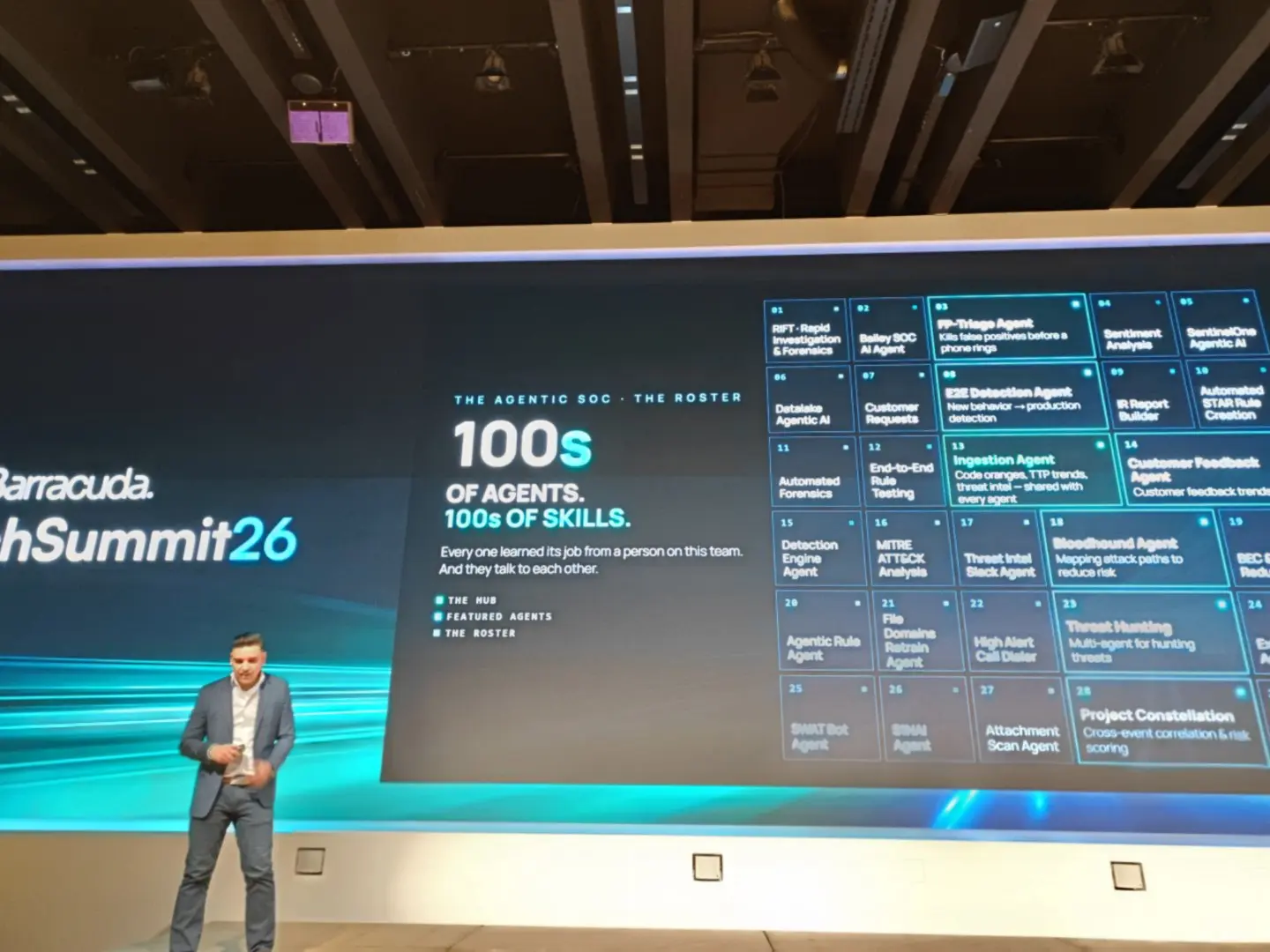
Downey and King point to identity as the new battlefield in security. “This is the easiest thing for attackers to exploit. With the right keys, attackers walk right through the front door, and people do leave their keys behind sometimes,” says Downey. “But ‘non-human’ identities pose just as much of a risk,” King adds. To better protect digital identities, Barracuda acquired Evo Security, but the integration is still in progress.
For Raynaud Schokkenbroek, Solutions Architect for the West European market, identity management should be at the top of every security leader’s list. “Identity is the heart of access to your data, processes, billing, to everything. It is one of the most targeted elements. Privilege management is closely linked to that. If someone does get in, limit their ability to move freely.”
Who decides?
Barracuda believes that the use of AI is necessary to stay one step ahead of attackers. Khan: “The time to intervene is shortening. Humans alone can no longer keep up with the volume and complexity of attacks. Attackers don’t use closed models, but tools that are widely available, such as Copilot and ChatGPT. It is inevitable that we as defenders must also use AI.”
We ask Khan how he sees the division of labor between human security experts and AI agents. “We have already made significant progress in automating response. AI can follow up on alerts and reach a determination much faster than a human. AI is good at analysis; humans are good at the logic and the governance around it.”
The governance aspect is crucial for Khan. “Speed requires guardrails, otherwise a crash is inevitable. Without guardrails, you trust something without knowing what you are trusting. In the past, you could ask an AI model the same question ten times and get ten different answers. Now models are more reliable, but critical thinking and human intuition remain important to connect the dots. That balance is important.”
Schokkenbroek adds an extra criterion from the implementation side: “it must not be disruptive. For things that are by definition a problem, automation can work, and a human then decides if it falls outside the usual cases. The human-in-the-loop helps the model to learn. But we should not automate where it benefits no one.”
Invisible vulnerabilities
After speed, visibility is one of the biggest challenges for security today, according to Barracuda CISO Arve Kjoelen. “If we can bring together threats, exposure, assets, and controls, our challenges become visible. That is precisely the problem: assets come and go in the cloud, which also makes vulnerabilities dynamic. Visibility disappears.”
Kjoelen illustrates with an example. The number of known CVEs increases year over year, but according to him, only the tip of the iceberg is known. “We simply don’t know how many vulnerabilities are in software. Researchers estimate that only ten, at most twenty percent, are known, and yet we continue to roll out new software.”
“With the use of LLMs, that could increase to sixty or seventy percent. LLMs discover many more critical vulnerabilities than humans. But then you also have to be able to patch those vulnerabilities. Remediation must therefore also automate. As a sector, we could do more with that ‘boring’ scientific work,” Kjoelen adds.
Behind every attack is a company
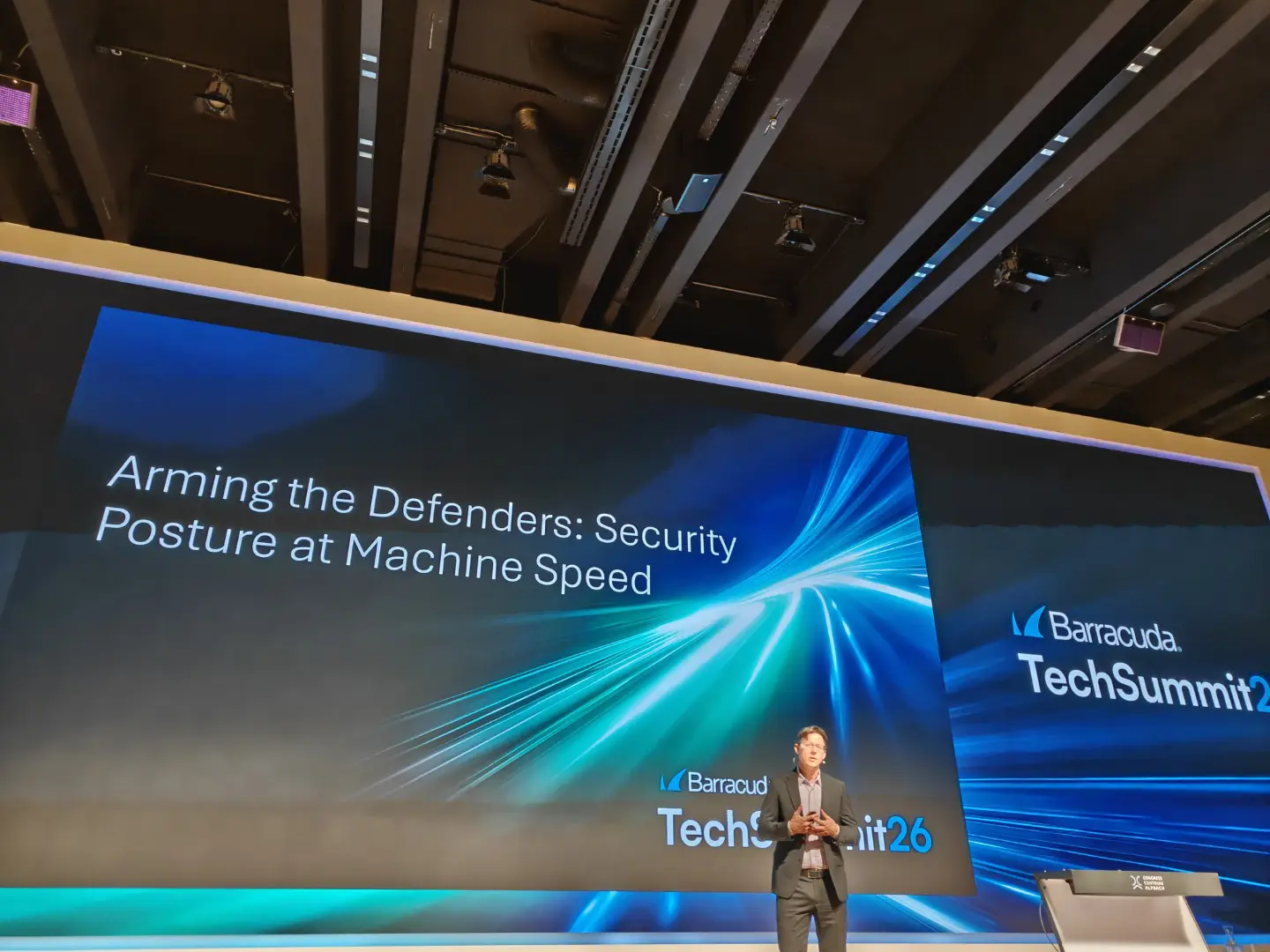
Barracuda’s work will be far from over after the TechSummit. Or as Khan puts it: “You don’t win the race with a PowerPoint”. Those words sound rather ironic during a conference where presentations follow one another quickly, and where Khan himself juggles slides full of figures. “But behind every figure and attack is a person or company that may or may not have had a bad day. We as defenders must never forget that”.
Khan’s biggest concern is when critical infrastructure is threatened. “We take things like electricity for granted. Society can only withstand a disruption for a short time before the fabric breaks. We must remain constantly alert”.
It is the logical conclusion of his own closing sentence. Behind every stopped attack is a person or a company that was not hit. That is what a security strategy must do, and that only happens in the field, not on slides.
Behind every attack is a company that may or may not have had a bad day.
Adam Khan, VP Global Security Operations & AI Barracuda