

Anyone wanting to share in the AI revolution starts with the network. HPE is putting both Aruba and Juniper front and center and sees a leading role for itself.
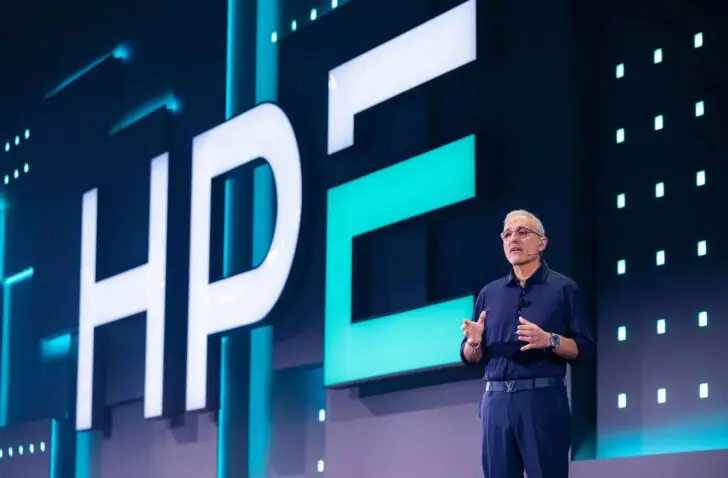
CEO Antonio Neri left no room for doubt at HPE Discover 2026 in Las Vegas about where he believes everything begins. “AI is only as strong as the data foundation beneath it. If that foundation isn’t right, nothing else will hold up,” he said in his keynote. And that foundation, as he built his case throughout the morning, is the network: “AI architecture starts with your network.”
It is no coincidence that HPE is delivering this message so emphatically. With the acquisition of Juniper (completed in 2025), the company extended its networking story from the campus into the data center and between data centers.
Modest cost item
Yet this is precisely where the first critical note is in order. No matter how central the network is according to HPE, it remains a modest item in the total data center budget. Rami Rahim, EVP and GM of HPE Networking, readily admitted as much: “In any given data center, the total investment in networking is relatively small, about 10 to 15 percent of the whole.”
The reasoning HPE uses to promote that 10 percent to a leading role was cited several times: a faltering network drains expensive GPUs. “Those GPUs you spent hundreds of millions of dollars on then run at 75, 50, or even 25 percent of their capacity,” Rahim said.

The argument is technically sound, but it doesn’t hide why networking is also interesting for HPE for another reason. Neri said it almost in passing: the network layer has “a margin profile that is totally different from classic compute.” The network as the foundation of AI is therefore as much a margin story as it is an architectural one.
One brain, two bodies
The most delicate chapter is not the hardware, but the merger of two networking cultures. Since the Aruba acquisition in 2015, HPE has already had a campus and branch portfolio. Juniper adds a second, parallel platform on top of that with Mist. HPE thus finds itself with two competing campus platforms in-house.
Mittal Parekh, senior director of product and solutions marketing, was given the thankless task of explaining this in a separate interview with us. His metaphor: “One brain, two bodies.” That one brain is Marvis, the AI engine. The two bodies are the AIOps platforms Aruba Central and Mist, both of which will continue to exist. “For the foreseeable future, both tracks will remain live, but they will both be powered by a single Marvis AI engine,” Parekh said.

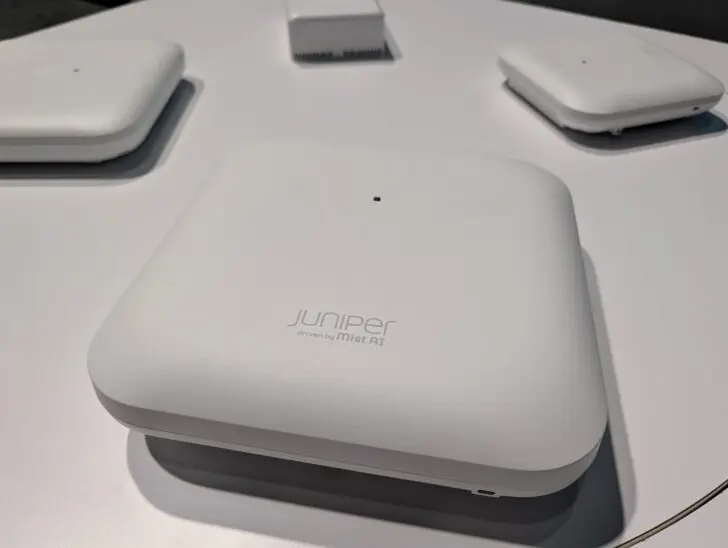
The trick to keeping that affordable is called microservices. “We write a small piece of code, and it doesn’t matter if it’s in C++ or Python, as long as it exposes APIs,” Parekh explains.
His metaphor: with the right whole-wheat flour, you can make a donut, a bagel, or a beignet. “That flour is Marvis AI.” The so-called cross-pollination is now visible: Aruba’s organization overview is moving to Mist, Marvis Actions is coming to Aruba Central, and Aruba CX switches will soon be managed by Mist as well.
How long is a ‘dual platform’ sustainable?
Maintaining two platforms costs money, and at some point, you have to choose. When we asked Parekh how long they would continue to invest in dual platforms, he deftly deflected the question: “I’ll give you the technical answer; you’d better ask Rami for the business or investment answer.”
No one wants to outline a real endgame. “I haven’t seen that crystal ball,” Parekh admits regarding the question of whether the two platforms will ever become one. For now, HPE is leaning on a ten-year promise to reassure customers, but that is exactly what it is: a reassurance, not a future path toward convergence.
Cross-pollination of features is not a merger. For customers, ‘no customer left behind’ is a great message today. The question of who will still want to maintain two separate consoles in five years remains unanswered.
Self-driving: strong demo, weak figures
When HPE isn’t positioning itself at the AI table to sell networking hardware in data centers, it switches to another AI trump card under the banner of the self-driving network. This is a network that monitors, diagnoses, and repairs itself, according to HPE.
When we press for practical usage—who actually turns on those autonomous features—Rahim remains vague. “I don’t know the exact number, so I’m not going to give you a number.” He did share that, in the meantime, “over 80 percent” of incidents resolve themselves or are immediately ready for an operator.
Parekh also dodged the question: “Without disclosing figures, I can say that adoption is very healthy.” The detail that autonomous actions are opt-in by default means that a sold self-driving network is not yet an enabled self-driving network.
The vendors know this best themselves, as evidenced by their analogies. Rahim compares it to Tesla’s evolution from cruise control to full autonomy; Parekh to car keys you don’t just hand over to your teenage son. “First, you have to build trust,” he says.
Much promised, now to deliver
To be fair: HPE has achieved a remarkable integration in one year. Five months after the official approval of the Juniper acquisition, the first joint products were already rolling out. The cross-pollination is there, and the Gartner recognition as a leader for wired and wireless LAN is significant. The full-stack story of network, compute, storage, and software under one GreenLake roof is more credible than that of many a competitor who, in Rahim’s words, “mostly shows slideware.”
The heroic role of a 10 to 15 percent budget item within an AI data center is as much a margin strategy as an architectural necessity. “Dual platform forever” reassures customers today, but only postpones the hard question of convergence.
The architecture is real, the components are impressive, and the freedom of choice between Aruba Central and Mist is an asset.
Yet HPE is still holding a few cards close to its chest. The margin ambition behind the networking rhetoric, the postponed choice between two platforms, and the autonomy that remains optional: for now, these are as much promises as they are proof. The trump card is on the table. Whether it wins the trick will be decided not by the keynote, but by the customer who dares to play along.