

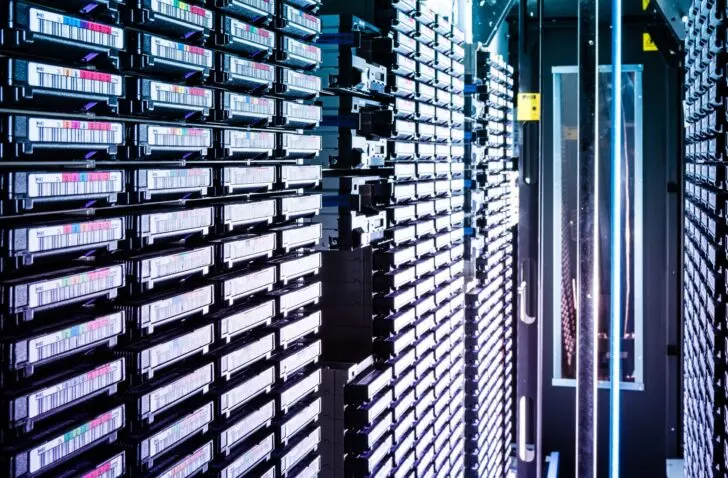
The impact of AI once again proves hard to overstate, as the hype is now also driving up demand for tape. Fujifilm plans to invest billions of yen to meet that demand.
The AI hype and the accompanying buildout of data centres worldwide are gradually reaching the furthest corners of the technology ecosystem. Demand for data storage is rising globally, and it is not just about fast flash memory or even HDDs. Tape is also increasingly sought after. Fujifilm explicitly points to the rise of generative AI to justify an investment of some 10 billion yen, about 56 million euros, in tape production.
No comeback
Magnetic tape is thus making a comeback of the never-been-away kind. The technology never fully disappeared at large enterprises and data centres. After all, tape offers a cost-efficient way to store large amounts of data safely. It is used almost exclusively for archiving or backups: the technology offers high density, but no non-sequential read or write capabilities. In other words: you have to play back the entire tape to read all the data.
Tape is also relevant for security. Organisations can take backups and keep them in a drawer (or vault), safely out of reach of ransomware.
Cheaper
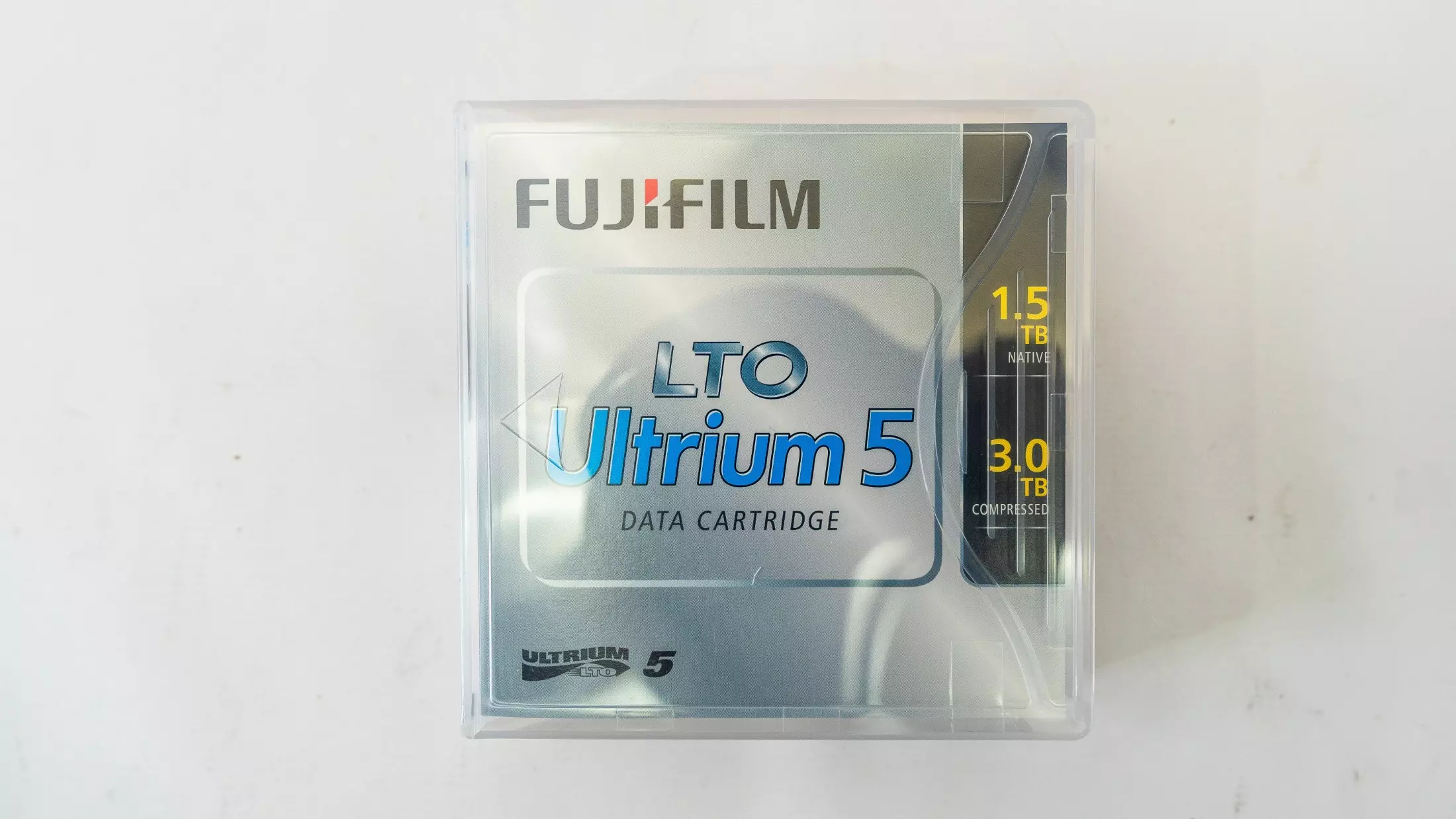
Price is also an important driver of its popularity. A single Fuji LTO Ultrium 10 tape with 30 TB of capacity, for example, costs about 260 euros excl. VAT. A Seagate Exos HDD with 28 TB of capacity costs roughly double: 580 euros excl. VAT. Large enterprises and data centres naturally do not negotiate prices per unit, but this gives an indication of the savings organisations can achieve with tape when it comes to backup and archive storage.
Fujifilm notes that magnetic tape has become more relevant in recent years, especially at large cloud providers. OVHcloud, for example, offers its Cold Archive, based on IBM tape technology. Meta already said in 2022 that it uses tape for its cold storage. By the end of 2025, CERN had generated more than an exabyte of research data, a large share of which is stored on some 60,000 tapes.
The technology has therefore not stood still. Since 2025, Fujifilm has used barium ferrite and strontium ferrite as magnetic particles. Innovations relate to the stability and reliability of tape as a medium.
A growing standard
Linear Tape-Open (LTO) has in fact been around since the start of the current millennium. The technology is based on an open standard, developed by IBM, HP and Seagate. Today, Sony and Fujifilm are the only remaining manufacturers of LTO cartridges. As with flash, HDDs and memory, the number of manufacturers in the global supply chain is thus limited. If demand rises, shortages loom unless there are major investments such as the one announced by Fujifilm.
The current standard is LTO-10. The technology has retained backward compatibility from the start, with cartridges that still have the same format (10.2 x 10.54 x 2.15 cm). Storage per cartridge has increased, though. The current generation of cartridges comes in a variant with room for 30 TB and a larger one that can handle 40 TB of storage. With compression techniques, the capacity of a single cartridge can rise to 75 TB and even 100 TB.
A roadmap towards LTO 14 speaks of 365 TB per cartridge (913 TB with compression).
The LTO consortium meanwhile continues to develop the technology. Whereas generation 6 could only hold 2.5 TB per cartridge, and generation 10 therefore up to 40 TB, generation 11 is to climb to 70 TB. A roadmap towards LTO 14 speaks of 365 TB per cartridge (913 TB with compression). As with HDDs, the quest for higher density in the same form factor continues unabated.
Stable demand
Fujifilm expects the growing relevance of data, driven by AI, to produce steadily rising demand for tape. The multi-million investment in new factories to build tape should create a proportionally growing supply chain. The aim is to produce mainly Ultrium 10 tape and to increase production capacity fivefold by 2028.
There currently seems to be no major shortage of tape. That contrasts with the situation for RAM, flash storage and hard drives. Availability there is insufficient, with far-reaching consequences for price and availability. Component manufacturers are getting rich from it, while those who depend on the parts pay through the nose or cannot get hold of them.
At the same time, the situation also creates opportunities for players such as Fujifilm and Sony, in a rarely highlighted segment of IT storage. Whether supply and demand stay in balance remains to be seen. The supply of tape drives, used to write to or read the cartridges, is in fact tight at the moment. IBM is the main supplier there.