

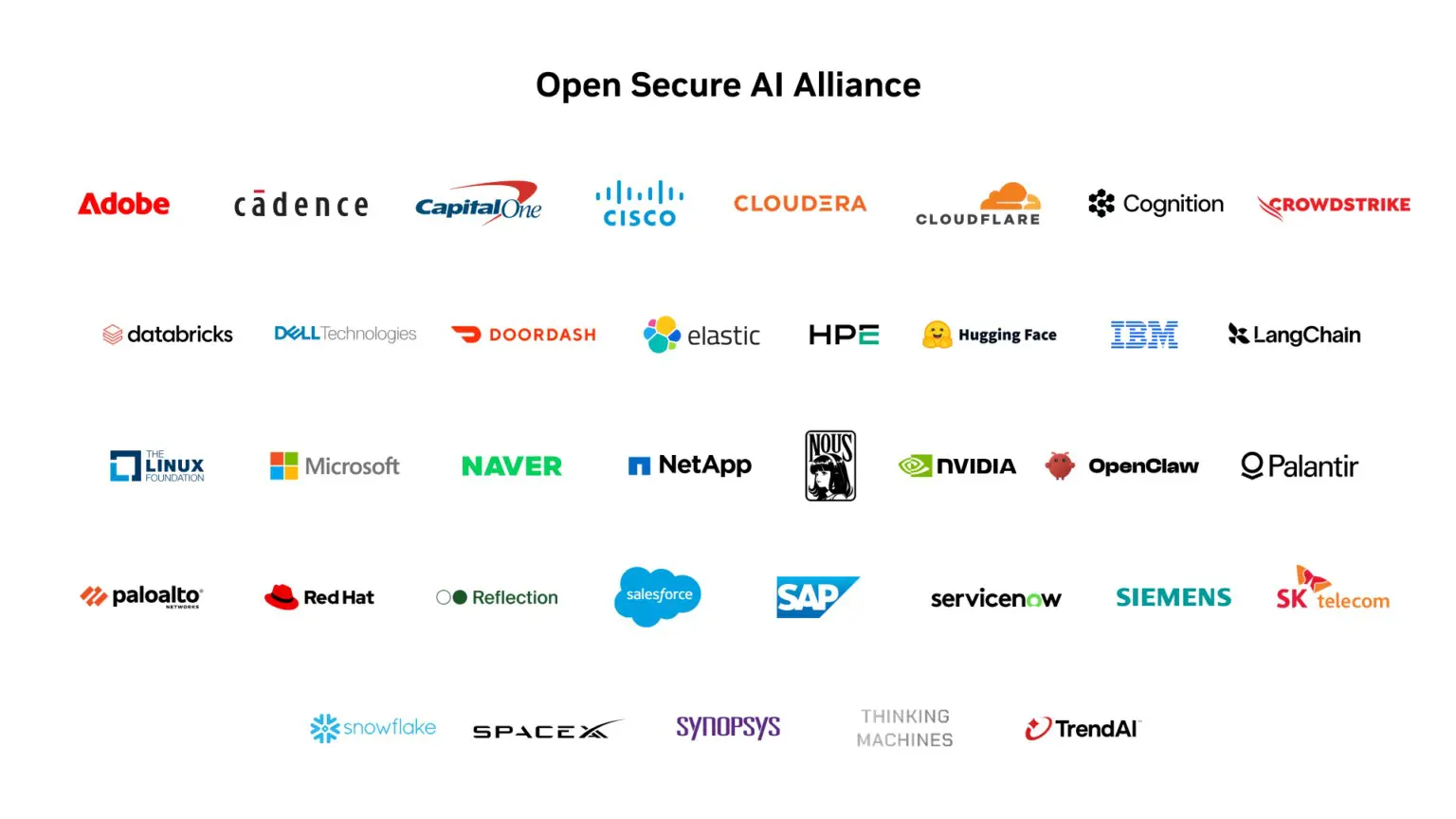
Almost the entire technology world is rallying behind the Open Secure AI Alliance, which aims to promote open-source AI. The major AI specialists with their top-tier models are conspicuous by their absence.
Nvidia has announced the launch of the Open Secure AI Alliance. The founding members are significant players. Nearly all major technology companies are putting their weight behind the initiative. Some notable standouts include Microsoft, HPE, Dell Technologies, IBM, SAP, Salesforce, Red Hat, Snowflake, Databricks, and the Linux Foundation. They believe that open-source software is critical to the global economy and see no exception when it comes to AI.
Driven to an X account
Databricks CEO Ali Ghodsi was vocal about the importance of open source during his Data+AI Summit last month. “I think it would be a huge risk if open source were to be banned,” he stated. “As long as open source exists as an alternative, universities and researchers worldwide can look inside the technology. If that disappears, only a handful of frontier companies will be left who are still allowed to look under the hood.”
“I think it would be a huge risk if open source were to be banned.”
Ali Ghodsi, CEO Databricks
This opinion is shared by the participants. Nvidia CEO Jensen Huang is even so passionate about the importance of open AI that he has created an X account. The AI guru, who had managed to avoid Musk’s social network until now, felt compelled to advocate for open AI with an open letter.
Fear of a ban
This appears necessary, certainly in the US. There, voices within the government are calling for restrictions on open AI. This is partly because the field of open AI, whether open source or open weight, is currently dominated by China. Think of Deepseek or GLM 5.2.
Open weight here means that the trained model with all its parameters is openly available as such, but not necessarily all the data it was trained on. The ‘weights’ refer to the core components of the LLM.
There is a fear that closed American models are being misused to train open models through so-called distillation. The US government, never shy about throwing the baby out with the bathwater, sees this as motivation to turn against open AI.
Open AI without OpenAI
The signatories of the open letter are largely the same organizations now rallying behind the Open Secure AI Alliance. Unsurprisingly, the letter was not signed by OpenAI, Anthropic, and Google. These three companies are also notable for their absence from the Open Secure AI Alliance.
The reason behind this is clear. The three parties are investing billions in the development of their so-called frontier models. These AI models are consistently the most powerful on the planet at launch. However, AI development moves very fast: a few months after launch, open models with similar performance usually appear.
Trillions at stake
This is not good news for the AI companies. OpenAI and Anthropic both have an IPO in mind and want to be valued at more than a trillion dollars. Such a valuation is hard to justify when a generic alternative to the flagship product is freely available worldwide within a year.
Nvidia couldn’t care less. Jensen Huang makes his money when AI models are trained and used. After all, that requires Nvidia accelerators. Whether those AI models are open or closed, an accelerator is running underneath. The more widespread AI becomes, the better it is for Nvidia.
LLM agnosticism
The other members of the Open Secure AI Alliance also benefit from the availability of plenty of AI, preferably open. Databricks and Snowflake, for example, position themselves as data platforms that are LLM-agnostic. They provide the framework that makes AI work; it is up to the customer to use a model of their choice as the brain.
Microsoft has also let the AI train pass. Despite everything, initial multi-billion dollar investments in OpenAI have primarily led to a soured relationship between the two. Microsoft now also sees its role primarily as integrating AI, and that doesn’t have to be with an expensive LLM from Anthropic or OpenAI.
SpaceX joins in
There is one striking participant in the Open Secure AI Alliance, and that perhaps explains why Huang suddenly has an X account. SpaceX, which is indeed building its own AI models with Grok, is a member of the collaboration.
Safety is paramount in the alliance’s announcement. The launch of the collaboration clearly has a lobbying function. The partners want to preempt any potential whispers in Trump’s ear regarding a ban, positioning openness as essential for (national) security rather than an obstacle.
Transparency ensures safety
The Open Secure AI Alliance argues that open models are not inherently less secure than closed ones. Both can be used for cyberattacks. Criminals will get hold of LLMs anyway, they say. A ban on open AI would then have the perverse effect of giving legitimate organizations less access to the tools they need to defend themselves.
From a security perspective, openness is a good thing. Open models can be tested by experts worldwide. In this regard, open AI is no different from open-source software. The more open it is, the more eyes are on the code, and the lower the chance of a bug. This stands in contrast to code (or AI) developed behind closed doors, where secrecy is supposed to be synonymous with security.
Concrete tools
Several participants in the Open Secure AI Alliance are contributing to making AI accessible for cyber defense. Nvidia provides open models, open weights, and harnesses for agents. Harnesses are the frameworks for LLMs that help determine what a model should and can do, and how.
HPE contributes with SPIFFE/SPIRE, which provides cryptographic security for the identity of AI agents. As a platform for open AI, Hugging Face also has every interest in its existence. That company is introducing Safetensors: a secure format for storing and sharing open AI models. Safetensors is being offered to the open-source PyTorch Foundation.
IBM and Red Hat are contributing Lightwell to the pool. Lightwell can autonomously resolve security issues. Microsoft also offers a harness with MDASH, which allows AI agents to discover bugs in a secure manner.
SpaceX is turning toward open source and making the code for Grok Build open. Furthermore, the company plans to open the weights of the Grok family of models to support developers and researchers.
A new divide
The formation of the Open Secure AI Alliance is the biggest step toward the development of open AI since the AI hype began. The collaboration does not oppose closed models and acknowledges that they also have an important place. Yet, its formation creates a clear split: the big tech companies are resolutely choosing the path of openness, and OpenAI, Anthropic, Google, and Meta will have to see how they fit into that narrative.