

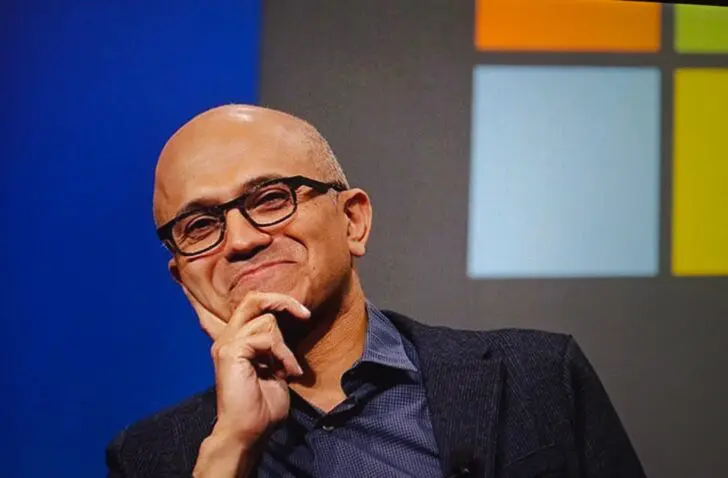
Microsoft CEO Satya Nadella is warning organizations about large AI companies, as they readily absorb valuable corporate knowledge without offering anything in return.
Anyone using AI shares corporate knowledge and information with the builders of AI models. Satya Nadella has come to this realization somewhat late. The Microsoft CEO notes that companies share their knowledge in many ways. The prompts people type, the questions they ask, and especially the corrections they make are extremely valuable to the builders of so-called frontier LLMs.
Knowledge is more than data
Sharing knowledge with an AI solution provider doesn’t necessarily happen due to inadequate data access control, although good policy around that naturally plays an important role. Simply by using AI, organizations are already transferring valuable knowledge, Nadella fears.
You essentially pay twice for intelligence: once with money and a second time with something even more valuable.
Satya Nadella, CEO Microsoft
“You essentially pay twice for intelligence,” says Nadella. “Once with money and a second time with something even more valuable: the proprietary knowledge you must reveal to make that intelligence useful. The better you want the model to perform, the more of that knowledge you have to put into it.”
Paradox
The Microsoft boss speaks of a reverse information paradox. The classic paradox, described by economist Kenneth Arrow, concerns the sale of information. A buyer of information cannot know its value until they have the info in hand, but by the time that happens, they already have the data and no longer need to buy it. Anyone offering information must reveal it for free to be able to sell it, effectively giving it away for free.
In the reverse paradox, the buyer is the one who loses out. They give away valuable information just to be able to use what they have bought. After all, an AI model only has value when it can work with the highest quality data possible.
One-way street
“Over time, the information asymmetry becomes increasingly skewed,” Nadella observes. “The seller learns more and more about you as you use what you have purchased, while you learn almost nothing about what the seller is learning about you in the process.”
Over time, the information asymmetry becomes increasingly skewed.
Satya Nadella, CEO Microsoft
Builders of frontier models essentially claim the right to learn from usage, while terms of use lock down the reverse. Through usage, you could learn how an AI model thinks and works. That process is called model distillation, and it is explicitly forbidden.
Who owns the means of production
Nadella advocates for better data protection. Not just data, but everything related to the use of an AI model must remain shielded from the model providers.
The comparison to the Industrial Revolution is not far off: who produces, who owns the means of production themselves. In the context of AI, that is not the case. You generally consume AI models via the cloud, according to the terms of the model providers.
No new insight
The CEO is right. He describes the same pain points as critics of the current AI system. Large platform providers are also making a similar analysis. LLMs must evolve into an interchangeable brain. Everything around it, including the harness (the software that manages the LLM’s operation in practice) and the orchestration layer, must be in the hands of the user.
There should be a wall between the model on one side and the harness and orchestration layer on the other: on one side sits the intelligence a company consumes, on the other side the corporate data, including prompts and other forms of knowledge tied to usage. We hear the same sentiment from the likes of Databricks, Snowflake, ServiceNow, SAP, Salesforce, and others.
Triple irony
The fact that Nadella of all people is speaking out to denounce the situation is more than ironic. You can take your pick of reasons why. After all, Microsoft has tried to ram Copilot down the throats of unwilling users without taking any of the above into account.
Copilot made its appearance everywhere. Where Office (Microsoft 365) once had a handy mobile app, you now have to struggle through layers of Copilot just to open a document or make a scan.
Looking at Microsoft’s broader activities, we notice that gathering usage data apparently isn’t such a problem when it comes to Windows. The telemetry Redmond tries to collect there is extensive, as are the methods for gathering the data. Just try using a Windows PC without a Microsoft account.
The pot calling the kettle black
More important than Windows or the AI implementation with Copilot is the hypocrisy of Nadella and Microsoft. It is no exaggeration to say that the company helped create today’s skewed situation.
OpenAI built the first GPT models and ChatGPT by the grace of Microsoft. Microsoft provided the billions needed to build the first LLMs. Azure was the infrastructure of choice.
When CEO Sam Altman was ousted at OpenAI, it was Microsoft that helped him back into the saddle in exchange for a seat on the board. OpenAI and Microsoft were exclusive partners for a long time, until the relationship began to sour. It wasn’t until early 2026 that the exclusive relationship came to an end.
Newly acquired insight
That prompted Microsoft to develop tooling that built in more separation between the LLM and the customer. Azure AI Foundry, for example, is supposed to be a solution to the problem Nadella describes. Copilot is also said to better guard that separation now. On the other hand, everything still runs on Microsoft’s infrastructure.
Nadella hits the nail on the head and defines a clear problem with AI today. However, the fact that Microsoft helped create that problem remains unaddressed.
The ill-conceived launch of ChatGPT set a snowball in motion that no one really has a grip on anymore. The builders of frontier models, including OpenAI but also Google and Anthropic, aren’t complaining. Microsoft hasn’t built its own LLMs, and that fact is likely the most important explanation for the sudden concern the CEO is now expressing.