

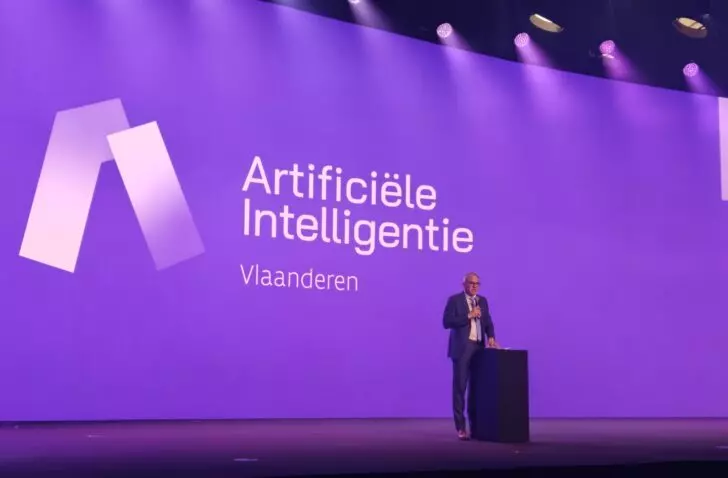
At the Flanders AI Forum, Flemish Minister-President Matthias Diependaele calls for more ambition with AI. Business experts show what that requires, and where the biggest challenges lie.
Flemish Minister-President Matthias Diependaele (N-VA) has only just returned from a working visit to China when he addresses the room at the Flanders AI Forum in Mechelen. Ambition is the key word of his speech: “The modest Fleming must dare to be ambitious,” he says. In SAP’s recent acquisition of the Ghent-based TechWolf, the minister-president sees proof that the Flemish tech landscape can aim for an ambitious role.
“AI is much more than a hype. It is important for our competitiveness and our prosperity.” According to Diependaele, the technology offers opportunities for productivity growth, because Flanders can innovate faster and compete more efficiently. “The combination of responsible innovation, knowledge and entrepreneurship is in the Flemish DNA.”
In the foreword, Sabine Demey, director of Flanders AI Research Program, and Jeroen Fiers, adviser at Vlaio, call for ambition in a more cautious tone. The question is no longer whether AI will have an impact, but what impact it will have. “We must be ambitious, but not accelerate blindly. Trust in what AI produces is not trivial. New models have new capabilities, which makes the choice harder,” says Demey.

Battle between the US and China
That road to ambition has plenty of speed bumps, Fiers warns. In the current geopolitical landscape, AI is a pivotal player in a struggle for global dominance between the US and China. “Billions are going into chips and models. Europe and Flanders are looking for their position in that. Technological leadership is strategic leadership. The downside is that limited access is not an abstract risk,” he says.
Europe must work out where it can make a difference and start from its own expertise. Fiers argues for applications with added value. “The acquisition of TechWolf shows that Flanders is in the game. Nothing is final yet with AI. But AI is not yet embedded strategically today. Companies remain stuck in experiments. A well-considered strategy is needed.”
Flemish frontrunners can pave the way. Besides TechWolf, Diependaele also praises Aikido as an embodiment of that “Flemish DNA”. According to him, the Flemish government invests 150 million a year in AI, supporting the ecosystem and startups. In early 2026, the Flemish government published its “AI Barometer”, which shows that AI adoption is rising quickly in Flanders.
“Every Fleming actually needs a kind of ‘toolb‑AI‑x’,” Diependaele wrote when announcing those figures. Unfortunately, he has no toolbox with him on stage, so which tools you need remains open to interpretation.
The combination of responsible innovation, knowledge and entrepreneurship is in the Flemish DNA.
Matthias Diependaele, Minister-President of Flanders
Searching for value
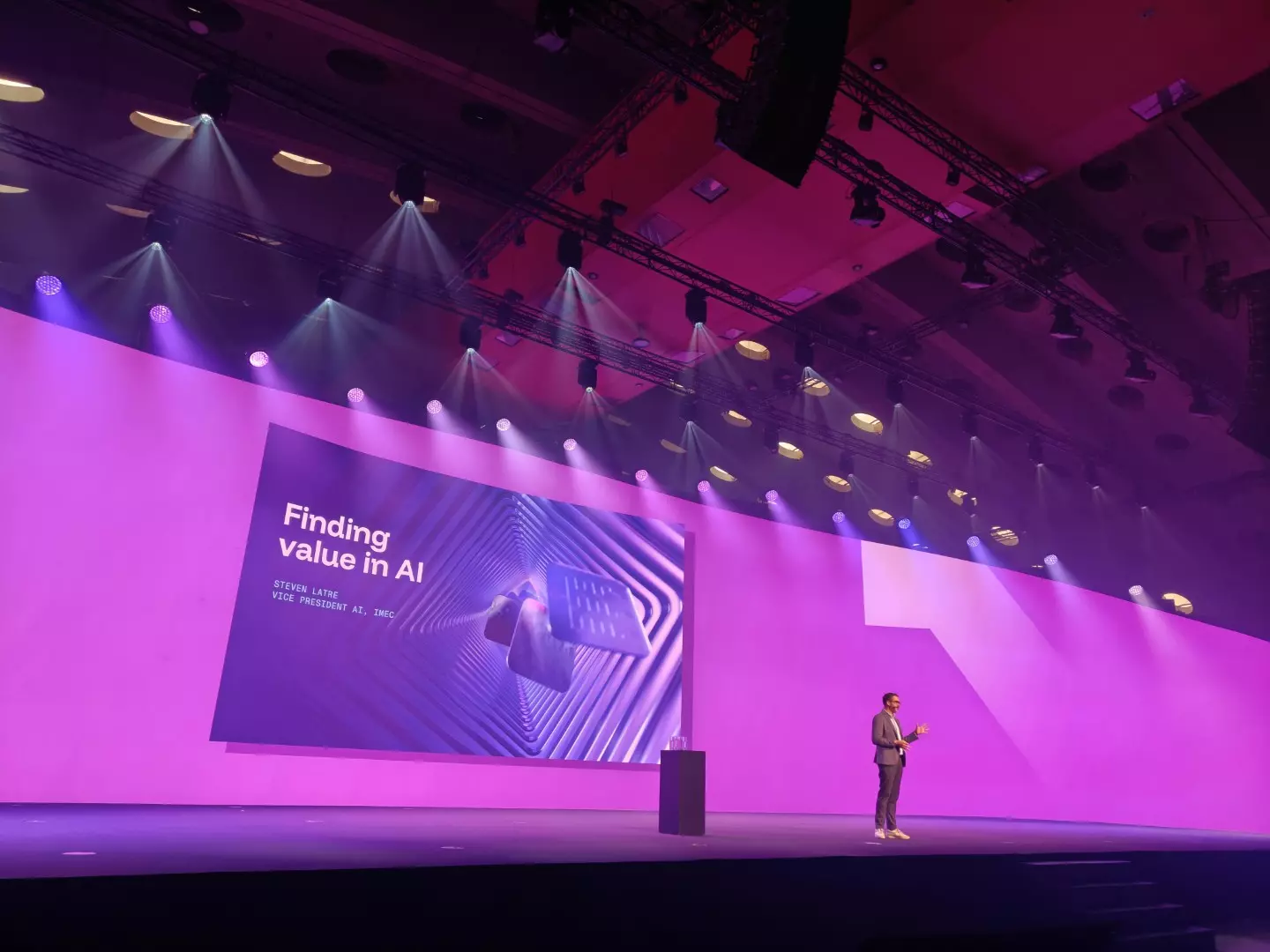
Steven Latré, VP at imec, kicks things off as the first guest speaker. According to him, the success of AI adoption depends on the value it delivers. “This is more than just a technology story,” says Latré, adding that it is almost as old as the internet. “The Telecommunications Act of 1997 created an open internet. 500 billion dollars of infrastructure was rolled out and many companies appeared on the application side, but profit margins were low.” He wonders whether an AI bubble will now follow the internet bubble.
“The value is there, but it has to be found,” he continues. “Today it again sits mainly in the chip and infrastructure sector. The European Union wants to invest ten billion euros in a massive rollout of AI factories. On the application side, it remains far more complex. OpenAI and Anthropic are making losses.”
According to Latré, anyone who implements AI naively will therefore get no results. “The costs are then too high compared with the intended value. Because model prices are based on tokens, what you use AI for becomes important. Where we find value, the impact is enormous.”
Token cost as a value gauge
For Latré, concerns about the cost of AI models and doubtful returns are no reason to throw everything in the bin. But a clear value gauge is needed to test AI projects against. Latré puts token cost forward: “The lower you get it, the better.”
That will not happen overnight, Latré admits. “It is a long process. Many companies start with simple implementations using one model and then move on to cost control with multiple models. Predictability and security are the next steps. The end point is that you also have control over the infrastructure, whether rented or rolled out yourself. But this is complex because of hard-to-get GPUs and the accompanying choice of model and software.”
20-60-20
Latré sees that AI projects often start from the wrong focus. “It is still too much about personal productivity. Simply giving employees an AI subscription does not work. Agents change the entire organisation.”
He refers to the “20-60-20” rule, devised by AI expert Julie Holmes, to define the division of tasks between people and agents. The theory states that humans do the first and last twenty percent of a task, while AI takes care of the time-consuming part in between. “People are there for the complex tasks and to define and verify what is needed. This is applicable to different tasks, as long as it is approached in a controlled way.”
Nicolas Deruytter, CEO of the Belgian AI company ML6, sees the impact of AI at three levels: personal, team and company level. His company focuses on the second level: “At this level, processes evolve into AI-led processes. If you take the AI away, it stops. The human only steps in when the system breaks. That requires more trust. Going too fast leads to misery,” says Deruytter, who speaks honestly from his own experience.
Elephants in the room
Latré names two “elephants in the room” that temper the enthusiasm around AI. The first is safety: “Without enough guardrails, agents look for ‘creative’ ways to solve their task. We are learning the hard way, but that does not mean the technology is unsafe.”
According to Latré, companies must develop harnesses around the models. “As a company, you are best off taking this part into your own hands. AI is the engine of your organisation, but a car is safe because of what surrounds the engine.” The second elephant is geopolitics: “With one stroke of a pen, your access to AI models can be denied.”
Deruytter sees public trust in AI turning. “Incidents with agents are becoming more serious and that frightens people. Big AI companies like to make the news. Others are starting to copy that tactic, which leads to more incidents. Fear sells, but in practice that is not a good thing.
According to Deruytter, consumers start from distrust. “The system has to prove its reliability.” The definition of reliable is not the same everywhere in the world. “The US, China and the EU hold very different values. In the US, anything goes as long as it makes a profit, in the EU the government focuses on regulation and protection of the individual, while in China the collective identity comes above all. Perhaps we should try to connect those values.”
Deruytter looks ahead to “superintelligence”, a term he does not use to be friends with Trump. “A hype in technology lasts about three years. We invested in it early. Superintelligence is a system that knows everything and comes up with solutions itself. That idea sounds fantastic, but it also raises justified concerns about privacy. What a system may do with what it knows is a relevant question.”
Fear sells, but in practice that is not a good thing.
Nicolas Deruytter, CEO ML6
Choppy waters
At an event like the Flanders AI Forum, practical stories also take centre stage. Pieter Van Bouwel, Data & Intelligence Manager at Port of Antwerp-Bruges, explains how the largest port in our country has tackled it. He divides the story into two periods, not coincidentally peppered with boat metaphors.
In 2019, the port started on a vision with limited resources, using predictive analytics and planning optimisation. Van Bouwel then felt like he was in a small rowing boat, gently lapping on the water. “The ship got bigger and bigger,” said Van Bouwel, and smart cameras and speech recognition were added. “Generative AI gave us new wind in our sails. With APICA we built our own assistant, first as a chatbot and then as an agent.”
The sea did not stay calm. “Now we are in a turbulent period. You can then either fight or run away.” According to him, a board that pushes to “do something with AI” is harmful. “You don’t release an agent into your organisation lightly. You have to onboard it, like a new employee.”
He also warns about AI-washing, shadow AI, rising token costs and digital laziness, where results are simply copied and pasted. “Everyone wants to ride the wave today. Make sure you don’t introduce chaos into your organisation. Take people along in a clear direction, with an eye for people, data and governance.”
You don’t release an agent into your organisation lightly. You have to onboard it, like a new employee.”
Pieter Van Bouwel, Data & Intelligence Manager Port of Antwerp-Bruges
Evy Meirsman, HR Manager at Port of Antwerp-Bruges, goes deeper into the human aspect. The port carried out an internal study on the potential of AI for employees. According to her, the impact depends on the task. “Will employees use the time that frees up to work more, less, differently or better? If you take away all the simple tasks, you actually increase the workload.” Meirsman argues for investment in personal development and process improvements.
Talent as raw material
Diependaele sees the potential mainly in small companies. “Talent is our raw material. The challenge lies in implementation and training. It is the government’s job to support companies in taking the step. The future will be written by the users,” Diependaele concludes his speech.
What that step requires is discussed at length during the Flanders AI Forum. The speakers point to token cost, trust in the technology, the embedding of AI in the organisation and the impact on people as factors that make or break AI. Flanders may and must be ambitious with AI, but the road to success will be bumpy.