

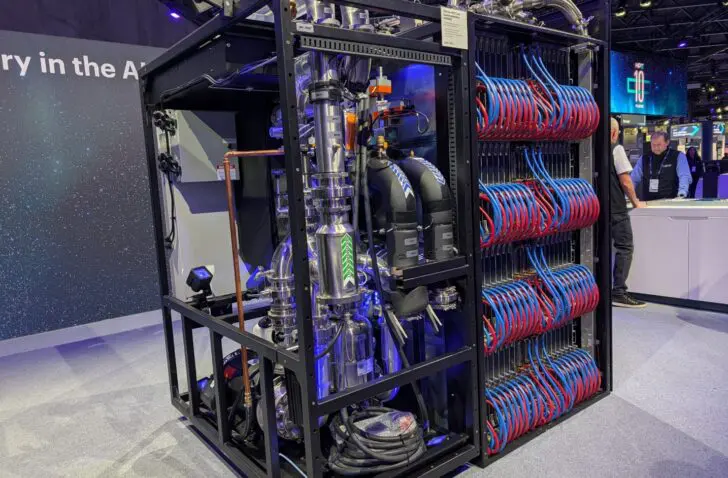
AMD and Nvidia are increasingly providing ready-made reference designs, which seems to be narrowing the playing field for system builders. HPE argues that the added value of Cray lies exactly where things get truly difficult: engineering, scale, and service.
At Discover 2026, HPE sees the market splitting into three segments. At the top is Cray supercomputing, still largely CPU-based and combined with GPUs for a true supercomputing mission. Below that is the AI layer, which relies heavily on strictly prescribed reference designs with little room for custom design. And finally, there is enterprise, where everything converges and where customers specifically do not want radically different solutions, so that hardware from various vendors can be easily linked together.
In that enterprise segment, HPE readily admits that differentiation is blurring. A solution from Dell will look very similar to one from Lenovo, simply because that is what customers want. Innovation there is shifting to the control system, software, and firmware, rather than the hardware itself.
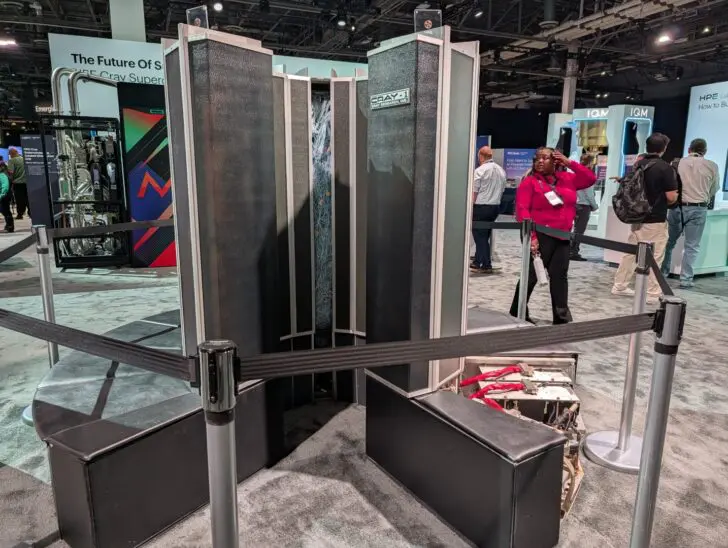
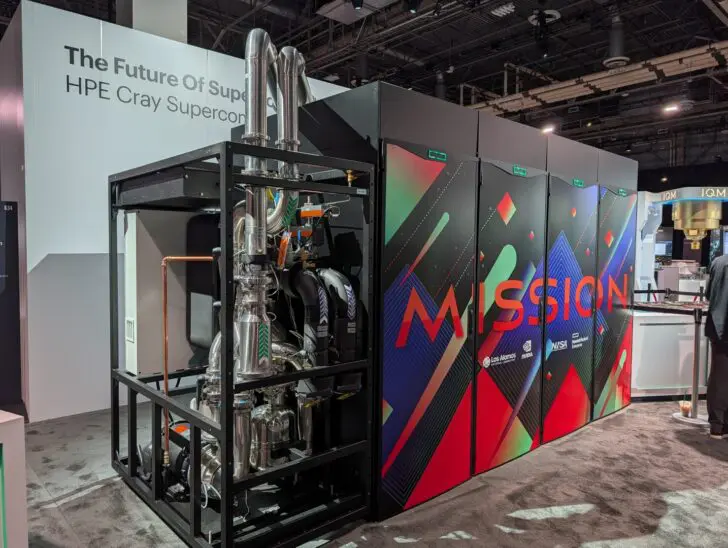
Supercomputers demand more
The story is completely different at the high end. When an organization like the US Department of Energy puts an exascale system out to tender, it wants the fastest and most energy-efficient system. According to HPE, this is exactly where a standard reference design falls short.
Today, Cray EX racks run at 400 kilowatts, more than double what Nvidia currently does with its designs. The cold plates are entirely designed by HPE, featuring 100% liquid cooling. According to HPE, this room to go beyond the norm is Cray’s raison d’être.
Even if reference designs eventually become completely locked down, HPE believes a clear differentiator remains: service and delivery. While some server vendors sell their systems, ship them, and wish the customer luck, HPE engineers are in the trucks. They install the hardware with proverbial white gloves, handle all the cabling, fill the systems with coolant, and run full benchmarks before anything even leaves the facility.
This takes place in their own factory in Wisconsin, where every liquid-cooled system—whether enterprise, supercomputing, or AI—is built and tested. This approach means that upon delivery after testing, a system is operational very quickly. The expertise to actually get large-scale systems up and running—since a data center or supercomputer requires much more than just delivering a box—is where HPE says it excels.
Full delivery
Furthermore, HPE does not want to limit itself to neatly executing someone else’s design. The company holds confidential talks with AMD, Nvidia, and suppliers of CDUs (Coolant Distribution Units) and power shelves to help guide the reference designs. In doing so, Cray brings its years of experience with large-scale systems, high water flow rates, and high power density to the table.
The conclusion is therefore nuanced. Many parties can deliver racks, but HPE positions itself as the provider of the complete solution, from the initial conversation to decommissioning after six or seven years. The monitoring of pumps, valves, and system health that the company developed for the Cray line is now trickling down to the rack-scale systems. Whether that remains enough to stay unique is an open question for now, HPE admits. It is still early days.