

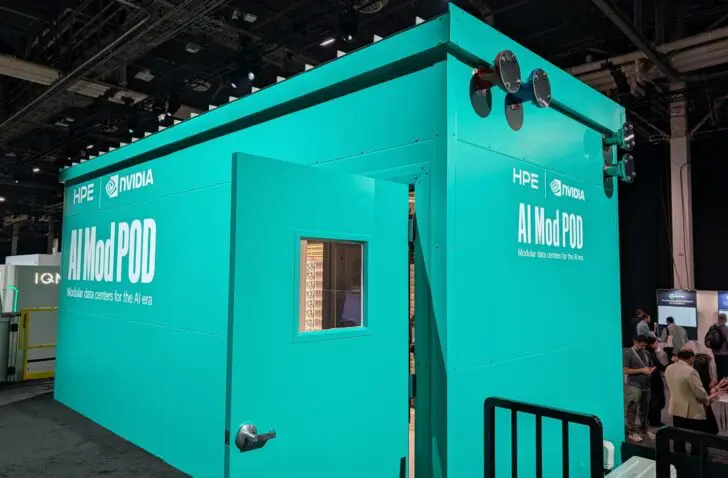
With the AI Mod Pod, HPE sells a complete data center as a single turnkey container that you place next to an existing building. At Discover 2026, HPE is promoting it as one of the fastest ways to install AI capacity without overhauling your old infrastructure.
The HPE AI Mod Pod is essentially a modular data center, built in a container and optimized for AI and HPC workloads. The idea is as elegant as it is practical: you might have an older data center, and next to it, you pour a concrete slab with prepared cabling and cooling. The AI Mod Pod is fully finished in the factory by HPE and then rolls onto the slab ready to use. The package includes its own ecosystem containing cooling, power, and everything else. You don’t have to change anything about the existing building.
According to HPE at Discover 2026, it is the only provider that integrates direct liquid cooling as standard in modular data centers. The units are delivered in compact and larger configurations and can be deployed almost anywhere power and connectivity are available. Delivery time is a few months instead of years, and the carbon footprint reportedly drops by 30 to 40 percent thanks to more efficient cooling.
The catalog: from DC8 to a full DLC Data Hall
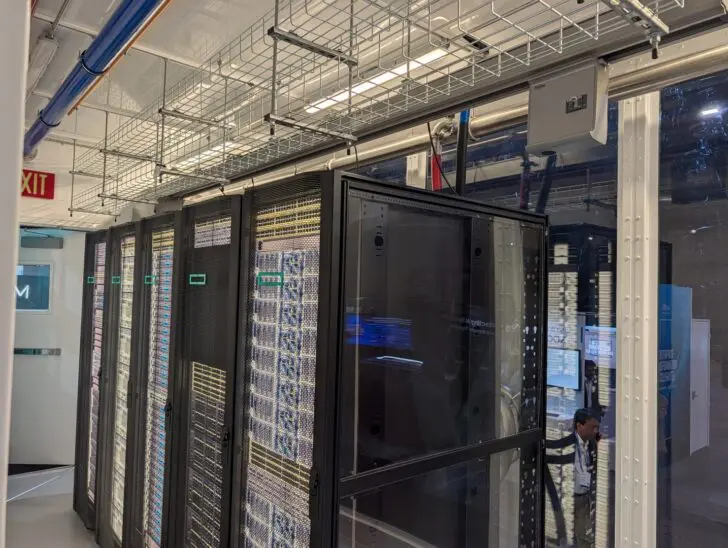
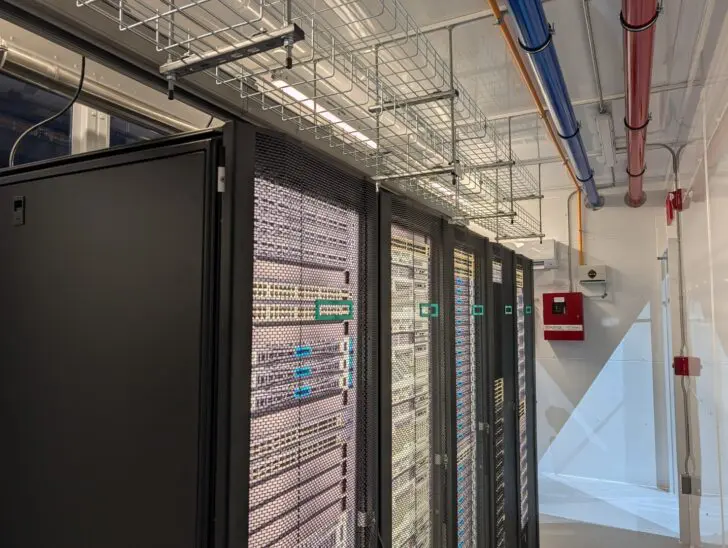
The standard HPE AI Mod Pod catalog consists of several building blocks. The DC8 DLC delivers up to 0.8 megawatts across 384 rack units, with a twenty-foot corridor and eight rack enclosures, accommodating six 120-kilowatt DLC racks and two 40-kilowatt air-cooled racks. The larger DC16 DLC doubles that to 1.6 megawatts across 768 rack units, with a 12.2-meter corridor, sixteen rack enclosures, twelve DLC racks, and four air-cooled racks.
Those who need more can combine these building blocks into a DLC Data Hall: any combination of DC8 or DC16 DLC, up to four containers together, providing up to five megawatts of IT power. XD or EX rack enclosures can be used within. The hardware is AI-optimized, featuring Nvidia AI computing by HPE, storage with data intelligence, intelligent networking, and direct liquid cooling.
The striking feature is that both liquid and air-cooled racks live side-by-side in the same Pod, which fits perfectly with the hybrid reality of many customers.
Isambard-AI as real-world proof
HPE demonstrates that the approach works with the Isambard-AI supercomputer at the University of Bristol. That five-megawatt system was installed on a brand-new concrete slab in just eight months, without touching the existing data center at all. The modular data enclosure itself was assembled in just 48 hours, reducing construction emissions by about 72 percent compared to traditional construction methods.
The project went from concept to working installation in less than two years, whereas it normally takes four to five years.
Isambard-AI runs on HPE Cray EX technology with more than 5,400 Nvidia GH200 Grace Hopper Superchips, fully fanless liquid-cooled, using exclusively carbon-free power and with a PUE below 1.1. The expansion plan immediately illustrates the scalability philosophy behind the AI Mod Pod: the site aims for a data center that can grow to dozens of megawatts via those same modular blocks.
200 containers at customer sites
Xavier Taillemite of HPE reports that there are currently 200 containers at customer sites and ten in production. On the military side, he says there is also demand for specific containers that are shielded against, for example, EMP attacks.
Taillemite says that an AI Mod Pod is very flexible in terms of connection and that they work with multiple manufacturers for chillers and energy. HPE often follows the customer’s lead regarding what is already on-site. Regions also often play a role, where some manufacturers are more active than others.
Those who choose liquid cooling must also select all IT in advance so that HPE can install everything as a single unit. The container then becomes twice as deep (two containers welded together). With air cooling, this is not necessary, and the customer can slide the IT in upon delivery.
Lock-in or flexibility?
Is such a container solution a kind of lock-in? Taillemite’s answer is nuanced: yes and no. The AI Mod Pod consists mainly of a metal shell with prepared cabling, piping, and a roof heat exchanger, but what’s inside can change. Liquid-cooled racks can be swapped out for new ones, as long as there isn’t an exponential difference in technology. If you want to switch from AC power to 800-volt DC, you have to recable, but the principle remains the same.
The real tie-in is in the warranty. As long as HPE handles the maintenance of the entire Pod, there is one phone number on the outside of the container that covers everything inside. If you suddenly want to put Dell racks in there, the contract changes. HPE describes the construction as very Lego-like: if you need more roof coolers, you install new ones; if you need new IT, you take the old ones out. The only thing that remains unchanged is the metal shell itself, which lasts for decades because it doesn’t rust.
If you’re still not satisfied, HPE will buy back the contents and you can recycle the container. For those who need AI capacity quickly without a construction site, the AI Mod Pod offers an attractive compromise between speed and flexibility.