

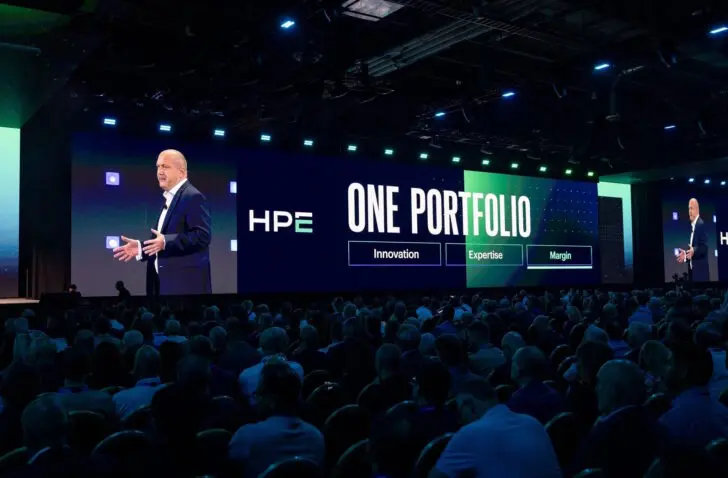
In recent years, HPE couldn’t stop talking about GreenLake, but at Discover 2026, the cloud platform is barely mentioned. Networking and AI are taking center stage. This invisibility isn’t a weakness: GreenLake has matured enough that it no longer needs a sales pitch.
Anyone comparing HPE’s keynotes at Discover 2026 will notice something striking. GreenLake, the company’s flagship for years, gets barely ten minutes of stage time in total. The rest of the stage, spread over more than three hours, goes to Juniper, AI agents, Morpheus, and self-driving networks.
For a platform that is currently one of HPE’s main growth engines, that seems strange at first glance. Until you flip the reasoning.
From visionary gamble to foundation
When HPE CEO Antonio Neri went all-in on GreenLake years ago, it was anything but a safe bet. The idea was simple but incredibly expensive: first, build a foundational layer—identity, security, a consistent cloud experience for hybrid environments—that every business unit could then build upon. No single product group could carry that investment alone, and the return would take years to materialize.
“GreenLake has come a long way,” summarizes Phani Koganti, Senior Distinguished Technologist within HPE’s Hybrid Cloud division. Koganti, who joined from AWS, recognizes the logic immediately. According to him, Neri looked at why hyperscalers became successful and concluded that you must invest early in shared, foundational platform services.
“Without looking immediately at ROI,” says Koganti. “You can’t just rely on a single business unit to invest in it and make it happen.” Today, that house is built, and you can build upon it.
And that gamble is paying off. GreenLake’s annualized revenue hit $3.2 billion at the end of fiscal 2025, a 62 percent year-over-year increase. For fiscal 2026, HPE is targeting $3.5 billion, with around 50,000 customers now on the platform. That’s music to investors’ ears: less dependence on volatile hardware cycles, higher margins, and stronger customer loyalty.
The platform you no longer need to sell
“At AWS, you never market the platform,” Koganti explains. A hyperscaler lays the foundation and then sells the services on top of it, not the foundation itself. HPE had to sell the platform story loudly at first, precisely to differentiate itself from traditional hardware vendors. But that chapter is largely closed.
The power of GreenLake today lies in what you don’t see: single sign-on, a single environment where compute, storage, and virtualization converge, and secure service-to-service communication that works zero-touch by default across thousands of tenants. The better that plumbing works, the less you notice it. “You evolve into a mature hyperscaler that no longer needs to talk about its platform everywhere,” says Koganti.
Additionally, the market now shares this insight. Gartner recognizes platform engineering as a full-fledged category, and HPE was one of the first non-hyperscalers to embrace the approach. The marketing groundwork has already been laid.
In a one-on-one conversation with a customer, there’s still a strong pitch, but on a stage with limited time, the platform must make way for what generates revenue in the short term. “The market expects a lot from HPE,” says Koganti, “so you see the focus on networking and virtualization.”
AI as a distraction? Not really
The pressing question remains: is AI stealing the spotlight that would otherwise fall on GreenLake? Koganti responds laconically. “That’s not how we think,” he says. GreenLake creates enormous internal value by bringing the networking, compute, storage, and software divisions together into a single whole. “That glue layer doesn’t need a show to do its job.”
The real reasons GreenLake is stepping off the stage are pragmatic and commercial. This is the first international Discover edition since the Juniper acquisition, so networking has to be front and center. Virtualization via Morpheus and VM Essentials is an acute opportunity now that customers want to move away from Broadcom’s more expensive VMware licenses. And of course, there’s AI, although it was quite modest compared to the rest of the IT industry. A breath of fresh air.
This is the first international Discover edition since the Juniper acquisition, so networking has to be front and center.
The consumption model behind GreenLake is no longer a differentiating asset but has become an expected baseline. Analysts predict that AI agents will reshape the way IT infrastructure is managed in the coming years. GreenLake moving to the background is therefore not an HPE quirk, but a symptom of a maturing market.
Invisibility as a mark of quality
In his own keynote, Neri calls a self-driving network “a quiet network, because it just works.” The same applies to a mature platform: the best compliment is silence. The fact that GreenLake can retreat into the wings without customers or revenue suffering is the strongest proof that the foundation is holding.
That doesn’t mean the story is finished. Koganti acknowledges that unification is a work in progress. He mentions the portals of Aruba and Juniper, but also OpsRamp, Zerto, and Morpheus. All these elements are only gradually changing color to a single palette. They are all branded as HPE now, but that’s just the beginning.
The next phase is taking shape. GreenLake Intelligence is intended to be an agent platform that brings HPE’s fragmented copilots together into a single composable layer of intelligence. That initiative is here now, but it will undoubtedly demand more stage time in the coming years.