

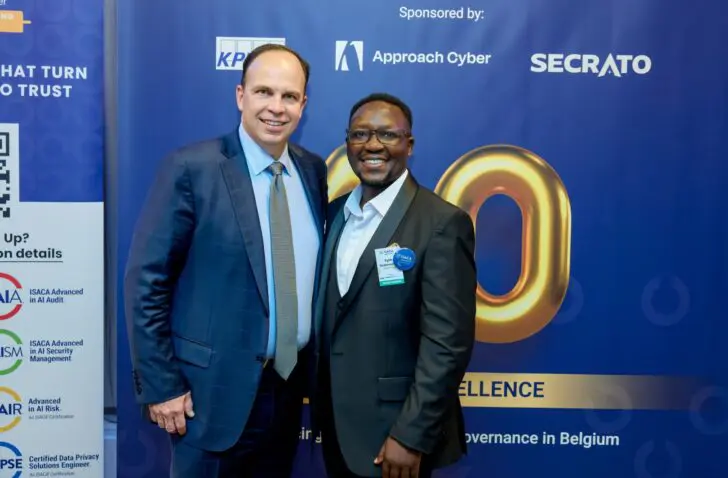
Certifications that were once updated every five years must now evolve almost continuously in the AI era. ISACA CEO Erik Prusch explains how the audit and security umbrella organization is reinventing itself, and why he believes humans are becoming more important, not obsolete.
The dynamic that occupies Erik Prusch most as CEO of ISACA on the human side is speed. Where certifications used to be updated every five years, that rhythm is unsustainable today. Updates must come more frequently to keep people qualified for the work they do.
This has consequences for the entire learning model. It is no longer enough to study for four or five months, pass an exam, and declare yourself ready, save for some ongoing professional development. New disciplines and new forms of learning must be added: a one-hour webinar, a short refresher course, other ways to transfer knowledge at the pace members can absorb it. The anchor itself, according to Prusch, does not change.
“Certifications currently remain the only way to demonstrably prove that someone possesses the required knowledge. What is changing is the method and the amount of time required.”
Three new AI certifications
In concrete terms, this translates into three new AI certifications, linked to the domains the organization has served for decades. There is AAIA for audit professionals, AAISM for security management, and AAIR for risk management.
Prusch emphasizes that they are a supplement, not a replacement for existing titles. They build on established credentials like CISA, CISM, and CISSP, so those who already have them can continue with the AI layer.
The reasoning behind it is that the threshold must remain low. The smaller the investment needed to make someone proficient, the more the work is, in a sense, democratized. “More people can then participate at a time when the talent shortage in the sector remains acute.”
The framework as a reference
For Prusch, the underlying framework is what holds all this movement together. “Without a basic framework, no one could navigate and you would never know where north is. The framework indicates the different domains you need to check off, and enables them to go into depth with confidence, knowing that the approach has proven itself over the years. The foundations don’t change that quickly; the implementation does.”
Hundreds of thousands of eyes worldwide, signaling in real time what is changing in the threat landscape.
Erik Prusch, CEO ISACA
What distinguishes ISACA in this regard, according to him, is the scale on which it builds its products. The organization has over 195,000 members spread across 190 countries, and those members voluntarily help build the products. “Hundreds of thousands of eyes worldwide, signaling in real time what is changing in the threat landscape. That material is processed into the products and shared back again.”
AI as a tool and as an audit object
An important nuance in his story is that AI is not only the object of control but also the tool. In the past, audit practice worked with samples; through technology, those samples can now become larger, more frequent, and more complete in what they test. Deploying AI in one’s own practice is just as important to Prusch as auditing AI itself.
That is immediately his answer to the fear that AI will make the auditor redundant. “Jobs will change,” he acknowledges, “because professionals will integrate AI into their daily work. The impact actually becomes greater because it reaches further.” It is, in his words, an exciting time to be in this profession.
Broader talent, different mindsets
Democratization also has consequences for who enters the sector. The auditor used to enter through a fairly fixed track. Now that needs to be broader, because the required skills must be able to reach across all sorts of domains that didn’t used to converge. It no longer has to be purely a mathematical or IT profile.
Prusch finds this a fascinating development. “Different mindsets bring different solutions, and different assumptions about what needs to happen. I expect the organization will also adjust its own thinking as a result. The profession is being recruited more broadly, and I see that as an opportunity rather than a loss.”
Treadmill or real progress?
A critical note is appropriate here. Permanent re-certification makes sense given the pace of technology, but it is also precisely the business model of a certification organization. Professionals who claim to hold ‘five or seven credentials’ already invest a lot of time to stay ‘on the edge.’ The question is legitimate whether a model of continuous updates is sustainable for the individual professional in the long run, or whether it amounts to a treadmill with a risk of credential inflation.
Prusch: “The job is not becoming simpler, but more complex. Audit has never become easier in thirty years, only more complicated. Continuing education is not an administrative burden, but the only way to keep the work feasible.” Whether that also protects the individual professional from exhaustion, the conversation left open.
The job is not becoming simpler, but more complex. Audit has never become easier in thirty years, only more complicated.
Erik Prusch, CEO ISACA
From the calculator to the next renaissance
Prusch concludes with an anecdote that nicely illustrates the distance traveled. When he started his first audit job in 1988, he was assigned a calculator with a paper roll. “Your skill was measured by whether you could type without looking at the keys. A mistake meant you had to start over, because there was no delete button.”
“From there, via Lotus Notes and Excel, to AI that anticipates what needs to be done. Not to mention quantum as a possible next stop.”
The real test of the AI era, viewed this way, is not whether technology can keep up the pace. It is whether the profession can follow the pace without exhausting the professional or eroding the value of a credential. Prusch is betting on the former. The coming years will show whether that optimism is justified.